Multi-Location SEO: The Complete Strategy Guide to Dominate Local Search at Scale
- March 24, 2026
- Local SEO
Quick Answer: What Is Multi-Location SEO?
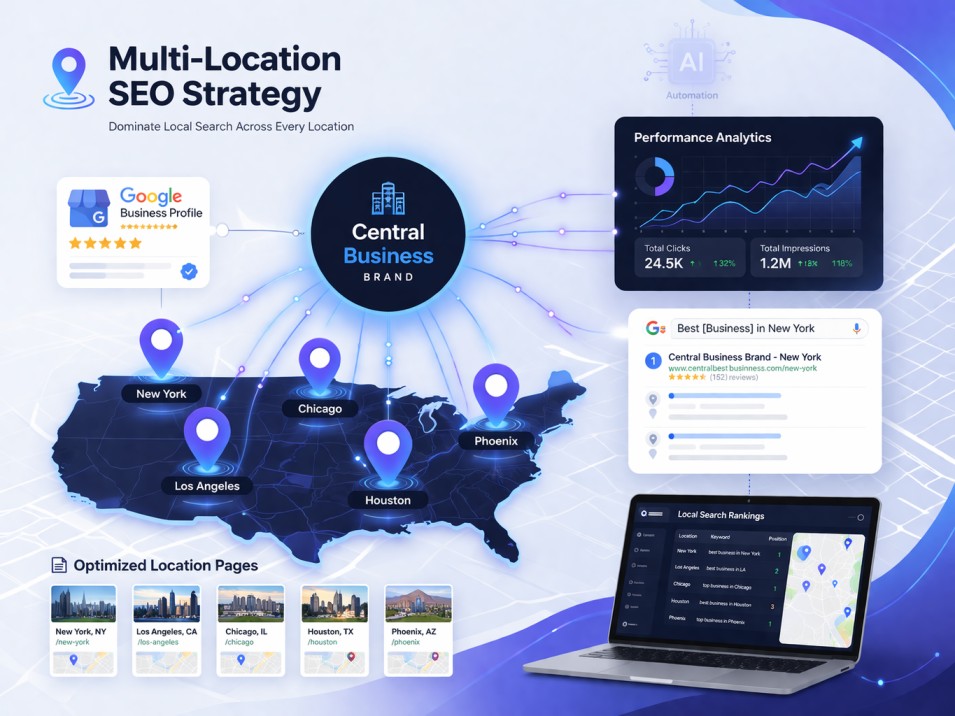
Multi-location SEO is the practice of optimizing a business's online presence across multiple physical locations to rank in local search results for each one. It involves creating unique location pages, managing Google Business Profiles, building local citations, earning reviews, and implementing a site architecture that avoids keyword cannibalization, all at scale.
Introduction
Consider this: 46% of all Google searches carry local intent. For a business with five locations, that is a significant opportunity. For a brand with 50 or 500 locations, it becomes either a powerful growth engine or an expensive mess, depending entirely on how well your SEO strategy is built.
What worked in 2022 and 2023 no longer cuts it. Copy-paste location pages with swapped city names, basic Google Business Profile setups, and a handful of directory listings used to be enough to get traction in local search. In 2025, those tactics actively hurt you. Google has grown smarter at detecting thin content, inconsistent entities, and sites that compete against themselves.
This guide is built for franchise owners, multi-location brand marketers, and SEO professionals who want a complete, honest, step-by-step playbook. We will cover everything from site architecture and location page strategy to GBP management, citation building, AI search optimization, and how to choose the right tools or agency for your scale.
By the end, you will have a clear system, not just a checklist, for achieving sustainable local search visibility across every market you operate in. If you would like expert help implementing any part of this strategy, reach out to Digital Web Magnate for a tailored multi-location SEO consultation.
What Is Multi-Location SEO? (Definition and Why It Is Different)
Multi-location SEO is not simply doing regular local SEO several times over. It is a fundamentally different discipline that requires a coordinated architecture, a governance framework, and a system for scaling quality content and signals across every location simultaneously.
Standard local SEO focuses on a single business in one geographic market. You optimize one website, one Google Business Profile, one set of citations, and one review stream. The strategy is relatively contained. Multi-location SEO multiplies every one of those elements, and introduces new challenges that do not exist at the single-location level: keyword cannibalization, authority dilution, inconsistent NAP data, and content duplication are all unique problems that emerge at scale.
National SEO, on the other hand, ignores local intent entirely. It targets broad keyword audiences across the country without the geographic specificity that drives visits, calls, and transactions from people physically near your locations.
Multi-Location SEO vs. Single-Location SEO vs. National SEO
| Factor | Single-Location SEO | Multi-Location SEO | National SEO |
| Target Geography | One city or neighborhood | Multiple cities or regions | Entire country |
| Location Pages Needed | 1 | One per location | None or generic |
| GBP Profiles | 1 | One per location | Not applicable |
| Content Strategy | Unified | Centralized and localized | Broad, topic-based |
| Primary Risk | Low competition | Cannibalization | Low local relevance |
| Citation Management | Simple | Complex, multi-platform | Minimal |
| Primary KPIs | Rank, calls, and visits | Pack visibility and conversions per location | Organic traffic and brand awareness |
Every business running more than one physical location, service area, or franchise falls into the multi-location SEO category. That includes franchise chains, healthcare networks, retail groups, restaurant brands, legal firms, and any service area business operating across multiple cities.
Why Local SEO Matters for Multi-Location Businesses (The Business Case)
Before investing in a complex multi-location SEO strategy, it helps to understand what the return actually looks like. Local search is not a niche marketing channel. It is where buying decisions are made, and the numbers back that up decisively.
Key Statistics You Need to Know
- 46% of all Google searches have local intent (Google)
- 97% of users search online to find a local business (SafariDigital)
- 28% of local searches result in a purchase within the same day (Google)
- 76% of people who search for something nearby visit a business within 24 hours (Think with Google)
- Near me type searches have grown over 900% in recent years (Think with Google)
- Businesses with complete Google Business Profiles receive 7x more clicks than those with incomplete profiles (Google)
What these numbers mean practically: each of your locations is sitting on a pipeline of high-intent local searchers who are ready to buy. The question is whether your SEO infrastructure is set up to capture them or send them to a competitor.
Why Local SEO Sometimes Fails for Multi-Location Brands
Even well-resourced brands with strong national authority repeatedly struggle at the local level. The failure modes are predictable and preventable once you know what to look for.
- Localized content: Crafting unique, relevant content for each location at scale is resource-intensive and often cut short
- Local citations: Maintaining NAP consistency across hundreds of directories becomes inconsistent without a system
- Local competition: Nimble single-location businesses often outrank chains in their own city because they have stronger local signals
- Review management: Monitoring and responding across all platforms for dozens of locations requires structured workflows
- Consistent brand identity: Balancing brand standards with local market customization creates internal conflict
- Keyword cannibalization: Multiple location pages targeting the same query compete against each other in search results
- Internal authority dilution: Link equity spread across too many thin pages reduces each page's ability to rank
Common Multi-Location SEO Mistakes That Kill Rankings
Most multi-location SEO failures trace back to a handful of structural problems. Understanding what goes wrong and why gives you a clear roadmap for what to fix first.
Mistake 1: Copy-Paste Location Pages (Thin Content)
The most widespread mistake in multi-location SEO is creating location pages by copying a template and swapping the city name. Google's algorithms have become sophisticated enough to identify these as near-duplicate pages, and they typically receive one of two treatments: they are not indexed at all, or they are indexed but never ranked because they provide no unique value to the searcher.
A strong location page does far more than name a city. It contains genuine local signals: real photos of the actual location, team members who work there, testimonials from local customers, answers to questions people in that specific market actually search for, and written context that makes the page feel like it belongs to that place. Anything less is content Google cannot trust or rank.
Mistake 2: Keyword Cannibalization Between Location Pages
When multiple pages on your site target the same keyword with the same intent, they compete against each other. Google cannot determine which page deserves to rank, so it splits attention between them, and neither performs well. This is especially common when service pages and location pages overlap on the same transactional query.
The fix is a clear keyword ownership model: each page on your site is assigned a unique target keyword and intent. Service pages own informational and broad commercial queries. Location pages own city-specific commercial and navigational queries. No two pages should be fighting for the same SERP position.
Mistake 3: Poor Site Architecture That Blocks Authority Flow
Many multi-location websites are essentially a pile of disconnected pages with no coherent hierarchy. When Google crawls these sites, it struggles to understand which pages are most important, how they relate to each other, and which locations should be prioritized.
A scalable architecture creates clear parent-child relationships: the main domain holds authority, the locations hub page distributes it, and individual location pages inherit it. Without this structure, PageRank cannot flow efficiently, and locations that should rank do not.
Mistake 4: Inconsistent NAP Data Across Directories
NAP stands for Name, Address, and Phone Number. When these three data points appear in different formats across the web, Google develops uncertainty about your entity. Is Dallas SEO Agency the same as Dallas SEO Agency LLC? Is Suite 200 the same as Ste. 200? These discrepancies seem minor but they create meaningful ranking instability, particularly in the local pack where entity confidence is a key signal.
Mistake 5: Treating GBP as a Set and Forget Asset
A Google Business Profile that was set up once and never touched again is a declining asset. Google rewards active profiles with higher pack visibility. Locations that go dormant lose ground to competitors who are posting updates, uploading photos, responding to reviews, and keeping their information current.
Mistake 6: Ignoring Behavioral Signals
In 2025, how users interact with your listings affects how Google ranks them. A location with consistent review activity, high click-through rates from search results, and regular GBP engagement outperforms a location that sits idle, even if the idle location has more reviews in total. Recency and engagement are what matter now, not just volume.
Mistake 7: Corporate Content Competing with Local Pages
When the corporate blog publishes a piece targeting a keyword that a location page should own, both pages end up competing for the same query. The result is that neither ranks as well as it would if the keyword ownership were clearly defined. Every tier of your site needs a designated content role.
Multi-Location SEO Strategy: The Complete Step-by-Step Framework
This is the core of the guide. The 12 steps below constitute a complete, scalable system for building multi-location SEO that compounds over time. Each step is a building block. Skipping any of them creates a gap that eventually limits your results.
Step 1: Collaborate with Location Managers and Stakeholders
No matter how well-designed your SEO strategy is, it will underperform without buy-in from the people running each location. Franchisees, branch managers, and regional operators hold information you cannot get any other way: the real name of the manager customers ask for, the service that drives the most walk-ins in their neighborhood, the community event they sponsor every year.
Begin with a structured outreach to every location stakeholder. Explain what you need, why it matters to their business specifically, and give them a clear deadline for response. Locations that engage early tend to see faster ranking improvements because the quality signals we need are available sooner.
In campaigns involving dozens of franchise locations, the pattern is consistent: locations with engaged operators outperform disengaged ones regardless of how strong the corporate SEO foundation is. Local input is not optional; it is a ranking advantage.
Step 2: Collect and Organize Location Data (The NAP Audit)
Before optimizing anything, you need verified, accurate data for every location. Do not rely solely on what franchisees or branch managers self-report. Cross-check against existing GBP profiles, the live website, and major citation platforms to identify discrepancies before they become ranking problems.
| Data Field | Why It Matters for SEO | Common Error to Avoid |
| Business or Branch Name | Entity consistency across the web | Abbreviations that differ by platform |
| Street Address | NAP consistency signal | Suite number format inconsistencies |
| Phone Number | Citation matching and CTR signal | Using toll-free instead of local number |
| Hours of Operation | GBP ranking and user experience | Holiday hours never updated |
| Business Email | Contact verification | Using generic info@ instead of local |
| Social Profile URLs | Entity association signals | Inactive or unclaimed profiles |
| Landing Page URL | Internal linking and crawl authority | Redirects to homepage instead of location page |
| Photos (minimum 10) | GBP engagement and trust signals | Stock photos instead of real location images |
| Years in Business | E-E-A-T trust signal | Often omitted from GBP completely |
| Products or Services per Branch | Keyword diversity opportunity | Same generic list across all locations |
| Unique Amenities | Differentiation for location pages | Never captured or published anywhere |
Step 3: Choose the Right Site Architecture
Site architecture is the most important technical decision in a multi-location SEO strategy. Get this right, and every future effort compounds. Get it wrong, and you will be fighting your own structure indefinitely.
The three structural options are separate domains, subdomains, and subfolders. The evidence strongly favors one of them.
| Structure | Example URL | Authority Inheritance | Scalability | Recommended? |
| Multiple Domains | location1.com, location2.com | None, starts fresh per domain | Poor, multiplies effort | No |
| Subdomains | dallas.brand.com | Partial and debated | Moderate | Rarely advisable |
| Subfolders | brand.com/locations/dallas/ | Full, inherits domain authority | Excellent | Yes (Best Practice) |
Subfolders inherit your main domain's authority directly. Every location page benefits from every link you have ever earned for the root domain. The ideal scalable architecture flows as follows: Homepage leads to the Services Hub and the Locations Hub, which each lead to Individual Location Pages. From those location pages, you can branch into Service-in-City pages when genuine search demand exists for that specific combination.
Create service-in-city pages only when keyword research confirms real search volume. Creating them speculatively produces thin content that dilutes your crawl budget and creates new cannibalization risks.
Step 4: Delegate Responsibilities Between HQ and Local Teams
One of the most common breakdowns in multi-location SEO is unclear ownership. When nobody knows whether corporate or the local team is responsible for GBP posts, both sides either do it redundantly or neither does it at all. Define roles before you launch the strategy.
| SEO Task | HQ Owns | Local Branch Owns | Shared |
| Site Architecture and Tech SEO | Yes | ||
| Core Service Pages | Yes | ||
| Location Page Templates | Yes | ||
| Location Page Unique Content | Yes | ||
| GBP Setup and Primary Category | Yes | ||
| GBP Posts and Photo Uploads | Yes | ||
| Review Responses | Yes | ||
| Local Social Media | Yes | ||
| Keyword Strategy | Yes | ||
| Local Blog and Community Content | Yes | ||
| Performance Reporting | Yes | ||
| Citation Management | Yes |
The hybrid model, where corporate controls strategy and technical infrastructure while local teams control execution and community signals, consistently outperforms both fully centralized and fully autonomous approaches. Brands that give local teams too much autonomy end up with brand inconsistency and duplicate content. Brands that give them too little miss the local signals that make individual locations visible in their markets.
Step 5: Create Optimized Location Pages That Actually Rank
A location page earns its ranking by being genuinely useful to someone searching in that specific city. Thin pages are a liability. A page that exists only to target a keyword without providing real local value is not an SEO asset. It is a ranking anchor that drags everything else down with it.
What Must Be Unique on Every Location Page
- Location-specific H1 and title tag, for example Plumber in Dallas TX
- Unique meta description with city name and primary service
- Localized intro paragraph, not just a city name swap
- Location-specific FAQs based on what people in that city actually search for
- Real photos of the actual location: interior, exterior, and team
- Local testimonials and reviews embedded on the page
- Team bios for staff at that specific location
- Community involvement, local awards, and partnerships
- Written driving directions and parking information
- Service-area description written naturally, not keyword-stuffed
- LocalBusiness schema markup with location-specific data
What Can Be Templated Across Locations
- Brand boilerplate and mission statement
- Core service list, with local prioritization noted where applicable
- Trust signals including certifications and guarantees
- Standard calls to action
- Legal disclaimers
- Navigation and footer structure
The distinction matters because Google does not penalize you for using templates. It penalizes you for providing nothing unique. Use templates to ensure structural consistency and save time on the elements that do not differentiate, but invest the effort in genuine local content for every element that does.
If you are building or auditing location pages and want an expert review, Digital Web Magnate offers comprehensive location page audits for multi-location brands.
Step 6: Optimize Google Business Profiles for Every Location
Your Google Business Profile is often the first thing a potential customer sees in local search. It appears before your website in the local pack, before your organic listing, and in many cases before any competitor. An incomplete or inactive GBP is a missed conversion at every search query where your business should appear.
GBP Optimization Checklist for Multi-Location Brands
- Claim and verify every location using Google Business Manager for bulk management
- Set the correct primary category that matches your core business type at each location
- Add relevant secondary categories, using different ones per location to expand keyword reach
- Write a unique description for each location, never duplicating copy across GBP profiles
- Upload at least 10 high-quality photos per location: exterior, interior, team, and services
- Add all services and products relevant to that specific location, not a generic corporate list
- Enable and actively monitor Q&A, proactively adding common questions with clear answers
- Publish GBP posts at least twice per month per location to maintain engagement signals
- Respond to all reviews within 24 to 48 hours, both positive and negative
- Keep hours updated consistently, including holidays and temporary schedule changes
- Add all relevant attributes such as wheelchair accessible, on-site parking, and dine-in available
- Link each GBP profile to its correct location-specific landing page URL, never the homepage
According to BrightLocal research, businesses that respond to reviews are significantly more trusted by prospective customers than those that ignore them. Responding is not just good customer service; it is a local ranking signal.
Step 7: Build and Manage Local Citations at Scale
A local citation is any online mention of your business's name, address, and phone number. Google uses citation consistency as a proxy for entity trustworthiness. When your NAP data is uniform across every directory where your business appears, Google gains confidence that the entity it is indexing is legitimate and stable.
For multi-location brands, citation management becomes a dedicated operational function. You are not managing one listing on five platforms. You may be managing 50 locations across dozens of platforms, each requiring accurate, location-specific data.
Citation Tiers for Multi-Location Brands
Tier 1: Essential Platforms
- Google Business Profile
- Apple Maps
- Bing Places
- Yelp
- Facebook Business
Tier 2: High Authority Directories
- Better Business Bureau
- Chamber of Commerce
- Foursquare
- Yellow Pages
Tier 3: Industry-Specific Directories
- Healthgrades for healthcare businesses
- TripAdvisor for hospitality and restaurants
- Houzz for home services
- Avvo for legal firms
Audit your existing citations before building new ones. Inaccurate listings already in the wild do more harm than gaps in your citation profile. Fix before you build.
Step 8: Build Review Velocity, Not Just Review Volume
A location that earned 400 reviews over four years can be outranked by a competitor with 120 reviews earned in the past six months. Review recency is a stronger signal than review volume in 2025's local pack algorithm. Google interprets a steady stream of recent, genuine reviews as evidence that a business is actively serving customers well right now.
The Multi-Location Review System
- Identify the right moment to ask: immediately after a completed service or positive customer interaction
- Create a standardized review request template for all locations across SMS, email, and in-person channels
- Use a QR code or short link to remove friction from the Google review submission process
- Build a response standard operating procedure defining who responds, how quickly, and in what tone
- Monitor review sentiment monthly per location to identify emerging service or reputation issues early
- Never incentivize or fabricate reviews. Google's review policies are enforced and penalties are severe
Review compliance is non-negotiable. Offering discounts, gifts, or any incentive in exchange for reviews violates Google's terms and can result in profile suspension. Every location in your portfolio is exposed to this risk if the policy is not enforced consistently.
Step 9: Build a Strategic Internal Linking Structure
Internal linking at scale is where most multi-location websites fail silently. Pages are created, content is published, but the links that would pass authority and guide crawlers through the site's hierarchy are missing or inconsistent. The result is that location pages that should rank are effectively invisible to Google because no authority is flowing to them.
The 3 Internal Linking Loops for Multi-Location Sites
Loop 1: Service to Locations
Core service pages link to the top-performing location pages for that service. A plumbing service page links to Dallas Plumbing, Houston Plumbing, and Austin Plumbing. This tells Google which locations offer which services and passes authority down the hierarchy.
Loop 2: Location to Services
Each location page links back to the relevant service pages offered at that location. The Dallas Plumbing page links back to the core Drain Repair, Water Heater Installation, and Emergency Plumbing pages. This reinforces topical authority and creates a closed linking loop.
Loop 3: Related Locations
Location pages link to geographically adjacent location pages using language like Also serving nearby neighborhoods in Plano and Frisco. This creates geographic clustering signals and passes authority between related location pages.
Step 10: Implement Local Schema Markup for Every Location
Schema markup is structured data that helps search engines understand your content with precision rather than inference. For multi-location businesses, LocalBusiness schema is one of the most impactful technical investments you can make because it directly improves how Google and AI systems understand and represent your locations.
Essential Schema Types for Multi-Location SEO
- LocalBusiness schema, or an appropriate subtype such as Restaurant, MedicalBusiness, or HomeAndConstructionBusiness, implemented on each individual location page
- FAQPage schema for FAQ sections on location pages and category pages
- BreadcrumbList schema to communicate your site hierarchy clearly to search engines
- HowTo schema for step-by-step service pages and guides like this one
- Review and AggregateRating schema to display star ratings directly in search results
Implement schema in JSON-LD format injected into the page head, not inline microdata. JSON-LD is Google's preferred format and is easier to maintain, validate, and update without risking markup conflicts with your page HTML.
Step 11: Leverage Your Locations to Diversify Keyword Rankings
Each location is a keyword diversification opportunity that most multi-location brands leave untapped. The instinct is to optimize every location page for the same primary keyword structure: service plus city. That approach creates competition between your own pages and fails to capture the full range of how local customers search.
Keyword Diversification Tactics
- Keep the primary GBP category consistent across all locations for brand coherence, but vary secondary categories to expand reach into different service queries at each location
- Use location-specific keyword modifiers beyond just city name: neighborhoods, local landmarks, zip codes, and near plus landmark phrasing
- Mine Google Search Console data filtered by each location page URL to discover which queries are already generating impressions but not yet clicks
- Use Google's People Also Ask results for each location's primary keyword and build FAQ sections directly from these questions
- Audit competitors' location pages in each city to identify keyword gaps you are not yet targeting
Step 12: Analyze Performance and Scale What Works
Multi-location analytics requires location-level granularity. Domain-level traffic reports tell you almost nothing about which locations are performing and which need attention. Set up your analytics and reporting to give you visibility at the individual location page level from day one.
Key KPIs to Track Per Location
- Local pack ranking position for the primary keyword in each city
- GBP metrics: clicks to website, phone calls, and direction requests, tracked as month-over-month trends
- Organic traffic to each location page, filtered in Google Search Console by URL prefix
- Conversion rate per location landing page: form fills, phone calls, and booking completions
- Review velocity: new reviews per month per location, and trailing average rating
- GBP photo views and Q&A engagement as engagement signal proxies
- Impression share versus top-3 local pack competitors per city
Identify your top-performing locations and document what distinguishes them. Higher review velocity, more complete GBP profiles, stronger local content? Whatever is working can be systematized and replicated across underperforming locations. This is how multi-location SEO scales effectively.
Corporate vs. Local Content: Who Owns What?
Content governance is the strategic framework that prevents keyword cannibalization and ensures every page on your site has a clear role. Without it, corporate teams and local branches naturally create overlapping content that competes internally rather than capturing external search demand.
What Content Belongs at the Corporate Level
- Broad educational blog content that applies to all customers regardless of location
- Core service and product pages that are consistent across all markets
- Brand story, leadership profiles, mission, and company history
- Industry research, white papers, and thought leadership content
- National press releases and PR content
A franchise plumbing brand's corporate blog should own articles like How to Detect a Hidden Water Leak. Not 47 location blogs all publishing variations of the same piece and competing for the same keyword.
What Content Belongs at the Local Level
- Location-specific landing pages with unique copy and genuine local signals
- Localized metadata including unique title tags and meta descriptions per location
- Location-specific FAQs based on what searchers in that market actually ask
- Local team bios, owner stories, and staff spotlights
- Community event coverage, sponsorships, and local partnerships
- Location-specific testimonials and case studies
- Region-specific service variations or pricing information
How to Prevent Keyword Cannibalization Across Locations
A keyword cannibalization audit is a non-negotiable step before launching or relaunching any multi-location SEO campaign. The process is straightforward.
- Map every existing location and service page to its intended target keyword and searcher intent
- Identify overlapping intent between corporate blog content and location pages
- Establish clear keyword ownership rules: corporate owns informational queries, local owns commercial and navigational queries
- Consolidate duplicate content using canonical tags or redirects to consolidate signals on the correct page
- Build a shared content calendar so corporate and local teams cannot unknowingly duplicate future content
Multi-Location SEO for Specific Industries
Every industry brings its own structural challenges to multi-location SEO. What works without modification for a franchise retail chain will need significant adaptation for a healthcare network or a restaurant group. Here is how the core strategy shifts by vertical.
Multi-Location SEO for Franchises
Franchise SEO faces a unique tension between brand control and franchisee autonomy. Franchisees often have strong local knowledge and community relationships but lack the SEO expertise to leverage them correctly. They may also insist on making changes to GBP profiles or location pages without understanding the downstream impact on rankings.
The solution is a hybrid governance model with clearly defined permissions. Franchisees are empowered to manage their GBP photos, posts, and review responses. Corporate retains control over categories, descriptions, and URL structures. Template disputes and GBP ownership conflicts should be resolved in writing before the campaign launches, not during it.
Multi-Location SEO for Healthcare and Medical Practices
Healthcare operates under the highest E-E-A-T standards of any industry. Google classifies health and medical content as Your Money or Your Life (YMYL), meaning the quality bar for ranking is significantly higher. Provider-level GBP profiles are often necessary in addition to practice-level profiles. Review sensitivity requires additional care in your response protocols.
Schema subtypes like MedicalBusiness and Physician should be implemented at the appropriate level of specificity. Ensure every provider biography includes genuine credentials, experience, and patient-facing information that demonstrates expertise and builds trust.
Multi-Location SEO for Retail and E-Commerce Brands
Retail multi-location SEO requires careful management of the in-store versus online intent split. Someone searching for a product near me has different intent from someone browsing product category pages. Location pages should be optimized for in-store visit intent with hours, directions, and available inventory signals where possible.
Integration with Google Shopping and the ability to show product availability by location are increasingly important for retail brands competing with pure e-commerce players on local queries.
Multi-Location SEO for Restaurants and Food Service
Restaurant SEO involves a broader set of platforms than most industries. Yelp, TripAdvisor, OpenTable, Google Food Ordering, and delivery aggregators all contribute to local visibility. Menu schema markup helps Google understand what you serve and surfaces menu items in rich results.
Seasonal menu variations require regular updates to both location pages and GBP profiles. Locations that keep their information stale through seasonal transitions lose visibility precisely when local search demand peaks.
Multi-Location SEO for Service Area Businesses Without a Storefront
Service area businesses (SABs) operate under different GBP rules than businesses with physical storefronts. Google allows SABs to hide their physical address and instead display a service area radius or list of cities served. This changes how location pages should be structured: instead of pages tied to a physical address, SABs create service-area pages targeting the cities and regions they serve.
Google's informal guideline of roughly a two-hour service radius applies here. Building pages targeting cities outside a reasonable service area, with no physical presence and no genuine customer base there, creates thin content that is unlikely to rank and may trigger quality filters.
Multi-Location SEO Tools: The Complete Comparison
The right tool stack can make multi-location SEO scalable. The wrong stack creates data silos, manual duplication, and missed signals. Here is how the leading tools compare across the categories that matter most.
| Tool | Category | Best For | Price Range | Multi-Location Feature |
| Semrush | All-in-One SEO | Keyword research and rank tracking | $119 to $449 per month | Location-level rank tracking |
| BrightLocal | Local SEO | Citation management and local rank tracking | $29 to $79 per month | Per-location reporting dashboards |
| Whitespark | Citations | Citation building and auditing | $20 to $100 per month | Bulk citation management |
| Moz Local | Citations and GBP | Listing management and sync | $14 to $20 per location per year | Bulk listing synchronization |
| Uberall | Local Listings | Enterprise multi-location management | Custom pricing | Built specifically for multi-location |
| Yext | Listings and Knowledge Graph | Enterprise brand consistency | Custom pricing | Centralized listing management at scale |
| GatherUp | Review Management | Review velocity at scale | $99 to $299 per month | Multi-location review workflows |
| Bullseye Locations | Store Locator and Pages | Scalable location pages and locator | Custom pricing | Thousands of location pages supported |
| GBP Manager (Google) | GBP | Free GBP management | Free | Bulk location editing and updates |
Which Tool Stack Is Right for Your Scale?
Under 10 Locations
Google Business Profile Manager, BrightLocal, and Semrush cover your core needs cost-effectively. Focus on GBP excellence and citation accuracy before investing in enterprise tools.
10 to 100 Locations
Add Whitespark or Moz Local for citation management at scale. Consider GatherUp for review workflows. Semrush remains the core for keyword and audit work.
100+ Locations or Enterprise
Yext or Uberall become cost-justified at this scale for centralized listing management. Custom reporting integrations connecting GBP data, GSC, and rank tracking become necessary. Digital Web Magnate works with enterprise multi-location brands on building these integrated reporting systems.
AI Overview and LLM Optimization for Multi-Location SEO
This is the section that no competitor has adequately addressed, and it is arguably the most consequential shift happening in local search right now.
Google's AI Overviews, ChatGPT, Gemini, and Perplexity are all generating answers to local intent queries. When someone asks an AI assistant to recommend a plumber near them or find the best dental clinic in their city, the AI is drawing from a curated understanding of entities on the web. If your locations are not recognized as clear, authoritative entities, they are invisible in these AI-generated responses.
Why AI Overviews Are Changing Multi-Location SEO
- AI-generated answers pull from structured, entity-clear content, not just the highest-ranked pages in traditional organic results
- Thin location pages with no clear service definitions and no structured data are passed over by AI models regardless of their organic ranking
- Zero-click search is growing as users receive direct answers from AI without ever visiting a website
- Large language models prefer content with direct definitions, clear lists, and concise summaries that can be extracted and cited
The implication is clear: optimizing for AI visibility requires the same structural discipline as traditional SEO, but with additional emphasis on entity clarity, schema markup, and content that is designed to be extracted and summarized rather than read end-to-end.
How to Optimize Multi-Location Content for AI Search (GEO)
Generative Engine Optimization (GEO) is the emerging practice of structuring content so that AI systems recognize, trust, and cite your business as an authoritative source. For multi-location brands, the six principles below are non-negotiable.
- Use definition-style answers for every major question on location pages, structured so they can be extracted verbatim or paraphrased by AI systems
- Structure all content with clear H2 and H3 heading hierarchies, as AI models parse headers to understand content organization before reading body text
- Add FAQ sections to every location page and implement FAQPage schema to make them citable by both Google's AI Overviews and third-party AI tools
- Keep service descriptions concise and specific, 50 to 100 words per service, with clear definitions of what is included
- Ensure NAP consistency everywhere your business is mentioned online, as entity clarity is the foundation of LLM recognition
- Earn citations and mentions from authoritative industry directories and local sources, as LLMs weight entities that are mentioned across multiple credible sources
GBP and AI Search: The 2025 Connection
Google's AI Overviews increasingly pull from GBP data when generating responses to local intent queries. A complete, active, well-reviewed GBP profile is not just a map asset anymore. It is a data source that AI systems use to understand your business and recommend it.
This means GBP completeness, photo freshness, review quality, and attribute accuracy all influence whether your locations appear in AI-generated local recommendations, not just in the traditional local pack. The behaviors that build strong GBP signals and the behaviors that improve AI visibility are largely the same. Building one builds the other.
Multi-Location SEO Agency vs. In-House vs. DIY: Which Is Right for You?
The hiring decision for multi-location SEO is one of the most consequential choices a brand can make. The right approach depends on your location count, internal capabilities, competitive environment, and budget. Here is an honest comparison.
| Approach | Best For | Pros | Cons | Estimated Cost |
| DIY | Small businesses with 1 to 5 locations | Low cost and full control | Time-intensive with steep learning curve | $0 to $200 per month in tools |
| In-House Team | Mid-market brands with 10 to 50 locations | Brand knowledge and fast execution | Hiring and training cost, limited specialization | $60,000 to $120,000 per year in salary |
| Multi-Location SEO Agency | Brands with 20+ locations or franchises | Specialist expertise and proven systems | Higher cost and requires clear briefing | $1,500 to $10,000+ per month |
| Hybrid: Agency plus In-House | Enterprise brands with 50+ locations | Best of both worlds | Coordination overhead required | $3,000 to $15,000+ per month |
What to Look for in a Multi-Location SEO Agency
- Proven case studies with multi-location or franchise brands specifically, not just general local SEO wins
- Experience managing Google Business Profiles at scale, not just single-location optimization
- In-house citation management capabilities or established partnerships with citation management tools
- A clear, location-level reporting framework with KPI dashboards you can access and understand
- Demonstrated understanding of keyword cannibalization and content governance at the site architecture level
- Track record within your specific industry vertical, as healthcare SEO differs significantly from restaurant SEO
Digital Web Magnate specializes in multi-location and franchise SEO strategy. If you are evaluating whether to manage this in-house or bring in specialist support, we would be happy to walk through your current setup and identify where the highest-impact opportunities lie. Reach out to start the conversation.
What Changes in 2025: The Evolution of Multi-Location SEO
The core principles of local SEO have not changed: relevance, prominence, and proximity still drive local pack rankings. What has changed is how each of these signals is built, measured, and weighted. Staying current on these shifts is the difference between a strategy that works now and one that worked three years ago.
Trend 1: Google Ranks Entities, Not Just Pages
Google's understanding of the web has shifted from page-level relevance to entity-level recognition. A business is now understood as an entity with attributes, relationships, and signals distributed across many platforms. When all of those signals are consistent and corroborating, the entity's authority is high. When they conflict, Google applies a discount.
For multi-location brands, this means every location must be a recognized, consistent entity across GBP, website, citations, and review platforms. This is not just a citation consistency issue. It is a strategic commitment to entity clarity across every touchpoint.
Trend 2: AI Overviews Reduce Organic Opportunity for Thin Pages
Google AI Overviews are appearing for a growing share of informational and local queries. When an AI Overview appears, it can significantly reduce click-through rates to the organic results below it. The pages that do receive clicks are those that AI Overviews cite or those that offer something the AI summary did not.
Thin, generic location pages receive neither. They are not cited in AI responses because they have nothing unique to contribute. They are not clicked because nothing differentiates them from the AI summary. Structural quality and genuine local content are now table stakes for capturing the organic traffic that remains.
Trend 3: Local Pack Stability Requires Behavioral Signals
Google Business Profile behavioral signals, including direction requests, phone calls, click-through rates, and photo view counts, are increasingly influential in local pack rankings. A location that is generating consistent engagement outperforms a location that ranks well on traditional signals but has low behavioral activity.
This is why GBP management is not a setup task. It is an ongoing performance channel that requires weekly attention from the team managing each location.
Trend 4: Voice Search and Near-Me Intent Continues to Grow
Voice search queries are conversational and hyperlocal. A voice search for a good Italian restaurant near me is structurally different from typing italian restaurant chicago, but both intents can be captured with the same foundation: strong GBP profiles, location pages with clear service and address data, and FAQ content written in the conversational phrasing people actually use.
Near me searches have grown over 900% in recent years and show no sign of slowing. Brands that optimize their FAQ content and GBP categories for conversational, near-me phrasing are positioned to capture voice search traffic as it continues to grow.
Trend 5: Multi-Channel Local Presence Is Now Required
Winning multi-location SEO in 2025 is not exclusively about Google. Apple Maps has significant market share among iOS users. Bing Places matters for voice search through Cortana and Siri. Waze influences driving decisions. AI assistant recommendations from ChatGPT and Gemini operate independently of traditional search rankings.
The brands that achieve dominant local visibility are those with consistent, complete, active presences across all of these channels simultaneously. The effort required to maintain them is substantial, which is another strong argument for investing in the right tools or the right agency partnership to manage it systematically.
Key Takeaways: Multi-Location SEO Checklist
Use this checklist to audit your current multi-location SEO status and identify the highest-priority gaps to address first.
Foundation
- Site architecture uses subfolders, not subdomains or separate domains
- Clear hierarchy in place: Homepage leads to Services Hub and Locations Hub, which lead to Location Pages
- No keyword cannibalization between service pages and location pages
- Internal linking loops connect service pages to location pages and related locations to each other
Google Business Profile
- All locations claimed and verified in Google Business Manager
- Correct primary category set per location, not a generic corporate default
- Unique descriptions for each GBP profile with no duplication
- At least 10 photos per location, refreshed monthly
- GBP posts published at minimum twice per month
- All reviews responded to within 48 hours
Location Pages
- Each location page has unique content beyond a simple city name swap
- Unique meta title and description per location
- LocalBusiness schema implemented on every location page
- FAQPage schema on location pages
- Real photos, local team bios, and local testimonials embedded
- Location-specific FAQs written from local search intent data
Citations and Reviews
- NAP consistent across all Tier 1, 2, and 3 citation sources
- Standardized review request process deployed consistently across all locations
- Review velocity tracked monthly per location
- No incentivized reviews anywhere in the portfolio
Content Governance
- Corporate owns educational blog content, core service pages, and brand content
- Local teams own location-specific FAQs, community content, team bios, and local events
- Keyword ownership mapped so no two pages are targeting the same intent
- Shared content calendar in place between corporate and local teams
Conclusion: Build a System, Not Just a Checklist
The most important insight from everything in this guide is deceptively simple: multi-location SEO that produces durable results is a system, not a series of one-time tasks. Every new location you open should plug into a proven architecture: a clear URL structure, a verified GBP profile, a unique location page, a citation management workflow, and a review velocity process that runs without requiring manual intervention every time.
Brands that build this infrastructure once and maintain it consistently compound their local search advantage over time. Every additional location strengthens the domain's topical authority. Every new review reinforces the entity signals Google uses to determine pack rankings. Every new citation validates the NAP data that underpins all of it.
Brands that treat multi-location SEO as a project rather than a system find themselves repeating the same foundational work with each new location, never quite getting ahead of the competition in each market.
The good news is that the framework in this guide works at any scale. Whether you are managing five locations or five hundred, the principles are the same. The tools and team structures change, but the system does not.
If you are ready to audit your current multi-location SEO infrastructure, identify the gaps, and build a strategy that scales with your business, the Digital Web Magnate team is here to help. Reach out today to speak with a multi-location SEO specialist, or request a free GBP and location page audit to see exactly where your highest-value opportunities are.
Frequently Asked Questions About Multi-Location SEO
What is multi-location SEO?
Multi-location SEO is the process of optimizing a business's digital presence across multiple physical locations to rank in local search results for each area. It includes creating unique location pages, managing individual Google Business Profiles, maintaining NAP citation consistency, building review velocity, and structuring a website that avoids internal keyword competition.
How is multi-location SEO different from regular local SEO?
Regular local SEO focuses on a single location in one market. Multi-location SEO scales this across many cities or regions simultaneously, requiring a coordinated site architecture, location-specific content strategy, centralized GBP management, and governance frameworks to prevent keyword cannibalization and diluted domain authority. These problems simply do not arise at the single-location level.
How long does multi-location SEO take to show results?
Most businesses see initial improvements within 3 to 6 months of implementing multi-location SEO. Significant ranking gains and consistent local pack visibility typically take 6 to 12 months. Timeline depends on market competitiveness, the current state of your GBPs and location pages, review velocity, and how consistently the strategy is executed.
Should each location have its own website or one page on the main site?
Each location should have its own dedicated page within the main website's subfolder structure, for example brand.com/locations/dallas/. Separate websites per location are rarely recommended because they cannot inherit the main domain's authority, making it significantly harder and more expensive to rank. One unified domain with location-specific subfolder pages is the established best practice.
What are the most important ranking factors for multi-location SEO?
The top ranking factors are: (1) Google Business Profile relevance and completeness, (2) review quality and recency, (3) NAP citation consistency, (4) location page content uniqueness, (5) proximity to the searcher, (6) website authority and internal linking structure, and (7) behavioral signals including click-through rates and GBP engagement.
How do I prevent keyword cannibalization across location pages?
Prevent keyword cannibalization by mapping every page to a unique target keyword and intent, ensuring no two location pages target identical queries, consolidating duplicated content with canonical tags or redirects, and establishing a content governance policy defining what lives at the corporate versus local level. Regular SEO audits catch new cannibalization before it compounds.
What tools are best for managing SEO across multiple locations?
The best tools include BrightLocal for local rank tracking and citations, Semrush for keyword research and SEO auditing, Whitespark or Moz Local for citation management, Yext or Uberall for enterprise listing management, GatherUp for review management at scale, and Google Business Profile Manager for free bulk GBP management. The right combination depends on your location count and budget.
How much does multi-location SEO cost?
Multi-location SEO costs range from $200 to $500 per month for DIY tool subscriptions covering 1 to 5 locations, to $1,500 to $5,000+ per month for a specialized agency managing 10 to 50 locations, up to $10,000 to $30,000+ per month for enterprise brands with hundreds of locations. Cost scales with location count, market competitiveness, and the scope of services required.
About us and this blog
We are a digital marketing company with a focus on helping our customers achieve great results across several key areas.
Request a free quote
We offer professional SEO services that help websites increase their organic search score drastically in order to compete for the highest rankings even when it comes to highly competitive keywords.
Subscribe to our newsletter!
More from our blog
See all posts