Google March 2026 Core Update: What It Is, Who's Affected & How to Recover
- March 29, 2026
- Google Update
Quick Answer
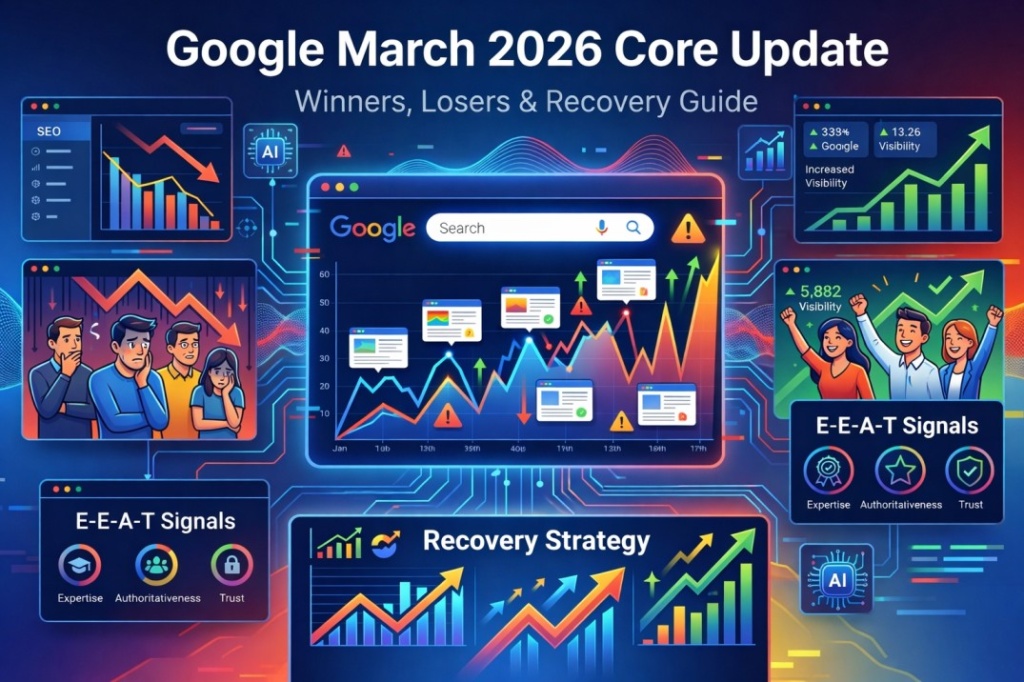
Google launched the March 2026 core update on March 27, 2026 — the first broad core update of the year. It is expected to complete rollout within two weeks. The update targets content quality across all site types, rewarding genuinely helpful, people-first content. It was preceded by the shortest-ever spam update in Google history (March 24–25, 2026).
📡 Rollout Status Tracker
Rolling Out — In Progress
| Announced By Google | March 27, 2026 |
| Rollout Started | March 27, 2026 — 2:00 AM PT |
| Expected Completion | ~2 weeks (early-to-mid April 2026) |
| Current Status | 🟡 In Progress |
| Announced Via | Google Search Status Dashboard + LinkedIn |
| Update Type | Broad Core Update |
| Preceded By | March 2026 Spam Update (March 24–25, 2026) |
What Is the Google March 2026 Core Update?
Definition — What Is a Google Core Update?
A Google core update is a broad, significant change to Google's ranking algorithms and systems. Unlike targeted updates (e.g., spam or product reviews updates), core updates reassess the overall quality and relevance of content across the entire web. Google announces these updates because they can cause notable ranking volatility across many websites simultaneously.
On March 27, 2026, Google officially announced the March 2026 core update via its Search Status Dashboard. According to Google, this is "a regular update designed to better surface relevant, satisfying content for searchers from all types of sites."
This is a broad core update — meaning it affects all types of websites, all industries, and all content categories. No niche is immune, and no specific behaviour is targeted. Think of it as Google recalibrating its entire understanding of what "quality" means in 2026.
What Makes March 2026 Different From Other Core Updates?
While every core update matters, March 2026 arrives at a uniquely significant moment in search history. Several converging factors make this update stand out:
- Longest gap since the last core update — The previous broad core update (December 2025) completed on December 29, 2025. The three-month gap allowed more ranking "debt" to accumulate, potentially amplifying this update's impact.
- The first-ever Discover Core Update came first — Google's February 2026 update was officially labelled as Discover-only — a first in Google's history — signalling more granular, vertical-specific algorithm management.
- Preceded by the shortest spam update ever — The March 2026 spam update completed in under 20 hours on March 24–25 — the fastest confirmed spam update in Google dashboard history. A spam sweep right before a core update is strategically significant.
- The AI search era changes everything — With Google AI Overviews, ChatGPT Search, and Perplexity now competing for attention, what "quality" means for ranking is converging with what gets cited in AI-generated answers.
Table 1 — 2026 Google Updates Timeline (Year-to-Date)
| Update | Date | Type | Duration | Status |
|---|---|---|---|---|
| February 2026 Discover Update | Feb 5–27, 2026 | Discover Core | 22 days | ✅ Complete |
| March 2026 Spam Update | Mar 24–25, 2026 | Spam | <20 hours (shortest ever) | ✅ Complete |
| March 2026 Core Update | Mar 27, 2026 – TBD | Broad Core | Up to 2 weeks | 🟡 In Progress |
What Does the March 2026 Core Update Target?
Google's Official Guidance on This Update
Google has not released detailed technical specifics about what signals changed in the March 2026 update — this is standard practice. Core updates are not "penalties" for bad behaviour. They are systematic re-evaluations of content quality across the web.
Google's official guidance remains consistent: there are no specific actions to take unless your content was already falling short of what Google considers genuinely helpful. As Google has previously stated:
📢 Google's Official Guidance
"There's nothing new or special that creators need to do for this update as long as they've been making satisfying content meant for people. For those that might not be ranking as well, we strongly encourage reading our creating helpful, reliable, people-first content help page."
Content Quality Signals Google Evaluates in Core Updates
While Google doesn't publish a ranking factors checklist, years of core update analysis — combined with Google's own documentation and the Search Quality Rater Guidelines — reveal a consistent set of signals:
- Helpfulness — Does the content genuinely serve the user's needs, or does it exist to rank?
- Expertise — Is the content authored by or reflecting genuine subject-matter knowledge?
- Authoritativeness — Is the site or author recognised as a credible source in their field?
- Trustworthiness — Is information accurate, transparent, well-sourced, and up to date?
- Originality — Does the content offer unique insights not available elsewhere?
- User Experience — Page speed, mobile usability, Core Web Vitals, and low ad clutter
- Search Intent Match — Does the content satisfy the searcher's actual underlying intent?
Which Sites Are Most at Risk?
| ⚠️ At Risk | ✅ Likely to Benefit |
|---|---|
| AI-generated, thin or bulk content | In-depth, expert-authored original content |
| Content created to rank, not to help | Genuinely helpful, user-first content |
| Sites with high ad-to-content ratios | Clean UX with well-structured, readable pages |
| Pages with weak E-E-A-T signals | Pages with strong author credentials & sourcing |
| Topically unrelated content clusters | Topically authoritative niche sites |
| Pages with high bounce rates | Content with strong engagement and dwell time |
| Unattributed, anonymous content | Content with clear author bios and credentials |
🔗External Authority Resource Google: Creating Helpful, Reliable, People-First Content
Google's own framework for what it considers high-quality content — essential reading.
Why the March 2026 Core Update Matters More Than Usual
- 3Months since last broad core update
- <20hDuration of preceding spam update (record shortest)
- 2wk Estimated rollout duration
The Gap Since the Last Core Update
The last broad core update — the December 2025 core update — completed on December 29, 2025. That's roughly a three-month gap before the March 2026 update arrived. While Google confirmed in late 2025 that smaller, unannounced core changes happen continuously, this is a significant period between major recalibrations.
A longer gap typically means that ranking advantages and disadvantages accumulated during that period will face a larger correction. Sites that gained rankings through low-quality content have had more time to benefit — and more to lose.
How the March 2026 Spam Update Sets the Stage
The March 2026 spam update completed in under 20 hours on March 24–25 — two days before the core update launched. This back-to-back sequencing is strategically significant and underreported by most outlets covering the core update.
Think of it this way: the spam update first cleaned out the most egregiously manipulative signals from the index. The core update then reassesses quality on a cleaner playing field. The combination likely amplifies the core update's reranking impact, particularly for sites that had been propped up by spam-adjacent link patterns.
Core Updates in the Age of AI Search
This is the context that most coverage of the March 2026 update is missing entirely. We are now operating in an era where Google's organic rankings and AI Overview citations are influenced by overlapping quality signals. A recent Search Engine Land report found that automated bot traffic is growing 8x faster than human traffic — signalling that how AI systems consume and cite content is becoming as strategically important as traditional SEO.
The core update signals that determine organic rankings in 2026 — E-E-A-T, content depth, authoritative sourcing, structured information — are the same signals that determine whether your content gets cited in Google AI Overviews, Perplexity, or ChatGPT's search results.
How to Tell If the March 2026 Core Update Hit Your Site
Before you take any action, you need to accurately diagnose whether and how the March 2026 core update affected your site. Many sites experience natural ranking fluctuations daily — not every drop is core update related.
Step-by-Step: Diagnosing Core Update Impact
01. Open Google Search Console — Performance Report
Go to Performance → Search Results. Set the date range to compare the 7 days before March 27, 2026 (baseline) vs. the 7 days after. Look for sudden drops in clicks, impressions, and average position. Filter by your most valuable pages first.
02. Check Which Pages and Queries Declined
In the Pages tab, sort by largest click decline. In the Queries tab, look for keywords where your average position dropped significantly (5+ positions). Note which pages lost featured snippets or were removed from AI Overviews.
03. Validate With Third-Party Rank Tracking
Cross-reference GSC data with tools like Semrush, Ahrefs, or Sistrix. Look for visibility index changes starting around March 27. If both GSC and third-party tools confirm a drop on the same date, the core update is the likely cause.
04. Check Index Coverage and Crawl Activity
In GSC, review the Index Coverage report for sudden drops in indexed pages. Also check the Core Web Vitals report — a poor UX score combined with content quality issues amplifies core update vulnerability.
05. Wait Before Drawing Final Conclusions
Core updates roll out unevenly. Don't make major decisions based on the first 3–5 days of data. Wait until at least one full week post-rollout before drawing conclusions. The rollout itself creates ranking turbulence that will stabilise.
Table 3 — Recommended Tools for Tracking Core Update Impact
| Tool | What to Monitor | Best For | Cost |
|---|---|---|---|
| Google Search Console | Traffic, impressions, position changes | Free first-party data | Free |
| Semrush | Keyword ranking movements, visibility index | Competitive SEO tracking | Paid |
| Ahrefs | Organic traffic value, ranking history | Link + ranking analysis | Paid |
| Sistrix | Visibility index changes | Domain-level impact assessment | Paid |
| RankRanger | Core update correlation reports | Agency-level reporting | Paid |
⚠️ Important Baseline Note
Use March 20–26, 2026 as your pre-update baseline window. If your site has seasonal traffic patterns, also compare year-over-year (same week in March 2025) to rule out seasonal factors before attributing changes to the core update.
How to Recover From the Google March 2026 Core Update
Recovering from a core update is not about finding a quick technical fix. It's about systematically improving the quality of your content until Google's next reassessment recognises the improvement. Here's the framework.
The 6-Step Core Update Recovery Framework
Diagnose Before You Act
Confirm the update actually affected you (see Section 4). Identify which specific pages lost rankings. Don't assume your entire site is affected — targeted page-level diagnosis is far more efficient than site-wide panic changes.
Run a Content Quality Audit on Affected Pages
For each impacted page, ask Google's self-assessment questions: Does this provide original insights? Would a knowledgeable person find this valuable? Are there factual errors or gaps? Would I trust this content with a medical, financial, or legal decision?
Strengthen E-E-A-T Signals
Add or improve author bios with verifiable credentials. Include first-hand experience, real case studies, and original data. Cite authoritative external sources. Add "last updated" timestamps. Link to your About page and author profiles.
Prune or Improve Underperforming Content
Identify pages with fewer than 10 clicks per month for 6+ consecutive months. Make a decision for each: improve (rewrite substantially), consolidate (merge with a related page via 301 redirect), or noindex (if keeping but not worth ranking). Never delete previously high-traffic content without redirecting.
Run a Technical Health Check
Review Core Web Vitals (LCP, INP, CLS) in GSC. Check mobile usability. Audit your internal linking structure — ensure your best content receives the most internal link equity. Verify that structured data (schema markup) is correctly implemented.
Be Patient and Track Incrementally
Set a 30-day and 60-day review milestone after rollout completion. Track week-over-week improvements. Google's biggest re-evaluation of improved content often comes with the next core update — consistent improvement is the long-term strategy.
Our full content audit framework for identifying and fixing underperforming pages.
What NOT to Do After a Core Update
- Make sudden, large-scale content deletions without redirects
- Disavow links unless you have a clear, confirmed manual spam problem
- Restructure your entire site architecture or URL structure in a panic
- Publish large volumes of new content hoping to "dilute" the impact
- Expect recovery within days — core update stabilisation takes weeks
- Assume a ranking drop means a penalty — core updates are quality reassessments, not punishments
E-E-A-T Actions That Directly Help With Core Update Recovery
Table 4 — E-E-A-T Improvement Actions and Their Impact Level
| E-E-A-T Signal | Improvement Action | Impact Level | Time to Implement |
|---|---|---|---|
| Experience | Add first-hand case studies, real examples, photos | High | 1–2 weeks |
| Expertise | Add author credentials, expert quotes, credentials section | High | 1–3 days |
| Authoritativeness | Earn mentions from trusted industry publications | High | 1–3 months |
| Trustworthiness | Add sources, dates, disclaimers, transparent About pages | Medium-High | 1–5 days |
| Content Depth | Expand thin pages with original research and data | High | 1–2 weeks |
| UX Signals | Improve page speed, reduce ad clutter, fix Core Web Vitals | Medium | 1–4 weeks |
| Internal Linking | Strengthen topic clusters, add contextual links | Medium | 1 week |
External Authority ResourceGoogle's Official Core Updates Documentation
Official guidance from Google on what core updates are and how to approach recovery.
Our comprehensive guide to building E-E-A-T signals that withstand core updates.
Google Core Update History — Timeline and Trends
Table 5 — Google Core Update History (2024–2026)
| Update Name | Start Date | End Date | Duration | Status |
|---|---|---|---|---|
| March 2026 Core | Mar 27, 2026 | TBD | ~2 weeks | 🟡 In Progress |
| December 2025 Core | Dec 11, 2025 | Dec 29, 2025 | 18 days | ✅ Complete |
| June 2025 Core | Jun 30, 2025 | Jul 17, 2025 | 17 days | ✅ Complete |
| March 2025 Core | Mar 13, 2025 | Mar 27, 2025 | 14 days | ✅ Complete |
| December 2024 Core | Dec 12, 2024 | Dec 18, 2024 | 6 days | ✅ Complete |
| November 2024 Core | Nov 11, 2024 | Dec 5, 2024 | 24 days | ✅ Complete |
| August 2024 Core | Aug 15, 2024 | Sep 3, 2024 | 19 days | ✅ Complete |
| March 2024 Core | Mar 5, 2024 | Apr 19, 2024 | 45 days | ✅ Complete |
Key Patterns and What They Tell Us
- Frequency is slowing down. In 2024 there were 4 broad core updates; in 2025 there were 3. Google is compensating with smaller, unannounced core changes running continuously, as confirmed in its December 2025 documentation update.
- Duration varies dramatically — from 6 days (December 2024) to 45 days (March 2024). This unpredictability makes patience essential.
- Spam updates are increasingly paired with core updates. The back-to-back combination in March 2026 is part of a broader trend of Google layering complementary updates.
- Vertical-specific updates are emerging. The February 2026 Discover-only update signals that Google is developing more targeted, vertical-specific algorithmic management alongside broad core changes.
Our full, regularly updated tracker of every Google algorithm update with analysis.
How the March 2026 Core Update Affects AI Search Visibility
This is the angle almost no one in the SEO industry is covering — and it's arguably the most important dimension of the March 2026 core update for forward-thinking publishers and marketers.
Core Updates and Google AI Overviews
Google's AI Overviews (previously known as Search Generative Experience / SGE) are now a permanent fixture in search results. What most SEOs don't yet fully appreciate is that the same signals that determine organic ranking also determine AI Overview citation eligibility.
When Google's AI system decides which sources to cite in an Overview, it draws on the same quality assessment framework as its organic ranking algorithm: E-E-A-T signals, content depth, authoritative sourcing, factual accuracy, and structured information. A page that benefits from the March 2026 core update is also more likely to appear in AI Overviews for related queries.
What Is Generative Engine Optimisation (GEO)?
Generative Engine Optimisation (GEO) is the practice of optimising content to be cited, referenced, or summarised by AI-powered search systems — including Google AI Overviews, ChatGPT Search, Perplexity, and Gemini. As core update signals and GEO best practices continue to converge, optimising for one increasingly means optimising for both.
How to Optimise Content for Both Core Updates and AI Visibility
- Write clear, direct answer paragraphs at the top of each major section — AI systems extract these for summaries
- Use a logical H2/H3 hierarchy that mirrors how a knowledgeable person would structure an explanation
- Provide definition-style answers for key concepts — these are prime targets for AI Overview extraction
- Include factual, citation-worthy data and statistics with clear attribution
- Add clear author credentials and publication/update dates on every article
- Use structured data (schema markup) — Article, FAQPage, HowTo schemas improve AI system understanding
- Write concise, self-contained paragraphs that make sense when extracted from context
Frequently Asked Questions — Google March 2026 Core Update
What is the Google March 2026 core update?
The Google March 2026 core update is a broad algorithm update launched on March 27, 2026. It is the first broad core update of the year, designed to reassess content quality across all website types and better surface helpful, relevant, people-first content in Google Search results. The rollout is expected to take up to two weeks to complete.
When did the March 2026 core update start and finish?
The March 2026 core update began rolling out on March 27, 2026 at 2:00 AM PT. Google estimates the rollout will take up to two weeks. The completion date has not yet been confirmed. Check the Google Search Status Dashboard for the latest rollout status. We will also update this article when Google confirms completion.
How do I know if the March 2026 core update affected my site?
Check Google Search Console for traffic and ranking changes starting March 27, 2026. Compare your performance data before and after that date using March 20–26 as your baseline. Look for drops in non-branded organic clicks, impressions, or average keyword positions. Cross-reference with third-party rank tracking tools like Semrush or Ahrefs.
What should I do if my rankings dropped after the March 2026 update?
Don't make rapid, large-scale changes. First, diagnose which specific pages were affected. Then audit those pages for content quality, E-E-A-T signals, and user experience issues. Improve or expand thin content, add author credentials, and fix technical issues. Google notes that the biggest recovery opportunity often comes with the next core update, not immediately after this one.
Does the March 2026 core update target AI-generated content?
Not specifically. Core updates assess content quality regardless of how it was produced. AI-generated content that lacks originality, expertise, or genuine helpfulness is more likely to be demoted. Content — whether human or AI-written — that is accurate, insightful, well-sourced, and user-focused is more likely to benefit from the update.
How is the March 2026 core update different from the March 2026 spam update?
The spam update (March 24–25, 2026) targeted spammy, manipulative content and link patterns — it's a targeted enforcement action. The core update (March 27, 2026 onward) is a broad quality reassessment of all content. They are separate systems with different purposes. The spam update completed in under 20 hours, the shortest on record, while the core update may take up to two weeks.
How often does Google release core updates?
Google typically releases broad core updates several times per year — there were three in 2025 (March, June, December). Between major updates, Google also runs smaller, unannounced core changes continuously, as confirmed in its December 2025 documentation update. The March 2026 update is the first broad core update of 2026.
Can I recover from a core update before the next one?
Partial recovery is possible between core updates if you make meaningful, sustained quality improvements. However, Google has indicated that the most significant re-evaluation of improved content typically occurs during the next core update. Consistent, ongoing improvements to content quality, E-E-A-T signals, and user experience are the most effective long-term strategy.
📌 Key Takeaways — March 2026 Core Update
- 📅 Launched March 27, 2026 — first broad core update of the year, rollout takes up to 2 weeks
- 🎯 Focus is content quality — relevance, helpfulness, and user satisfaction across all site types
- ⚠️ At risk: thin, AI-generated, and SEO-first content; weak E-E-A-T signals; high ad-to-content ratios
- ✅ Likely to benefit: original, expert-authored, genuinely helpful, well-structured content
- 🔧 Recovery strategy: diagnose affected pages, audit quality, improve E-E-A-T, fix UX — then be patient
- 🤖 AI search matters now: core update signals overlap significantly with Google AI Overview citation eligibility
- 📊 Context: preceded by the shortest-ever spam update and a 3-month gap since December 2025 core update
- 🔄 Biggest recovery: typically occurs during the next core update — sustained improvement is the strategy
About us and this blog
We are a digital marketing company with a focus on helping our customers achieve great results across several key areas.
Request a free quote
We offer professional SEO services that help websites increase their organic search score drastically in order to compete for the highest rankings even when it comes to highly competitive keywords.
Subscribe to our newsletter!
More from our blog
See all posts