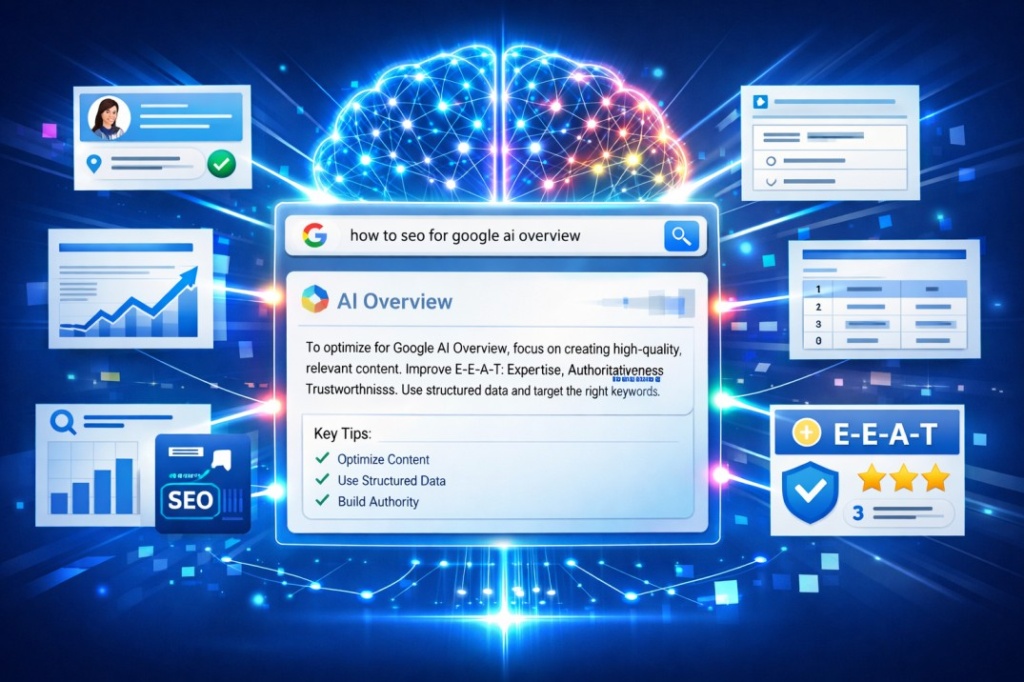
| Quick Answer: To optimize for Google AI Overviews, create structured, authoritative content that directly answers user questions. Use clear headings, concise paragraphs, and schema markup. Rank in the top 10 organically, build topical authority, include FAQ sections, and earn citations from trusted sources. Google AI pulls from content that is accurate, well-organized, and E-E-A-T compliant. |
Google's search experience has changed more in the past two years than in the previous decade. The rise of AI Overviews, powered by Google's Gemini language model, has fundamentally shifted how users interact with search results. And for anyone running a website, a business, or an SEO strategy, ignoring this shift is no longer an option.
This guide breaks down exactly how to SEO for Google AI Overview. You will learn what triggers these AI-generated summaries, why being cited inside one is now one of the highest-value positions on Google's SERP, and the practical eight-step framework our team at Digital Web Magnate uses to help clients earn consistent AI Overview visibility.
Whether you are a business owner trying to understand the new search landscape, or a marketing professional building a forward-looking content strategy, this guide gives you everything you need to adapt and win.
What Is Google AI Overview?
Google AI Overview is an AI-generated summary that appears at the very top of Google's search results page, above organic listings and featured snippets. It synthesizes information from multiple web pages to deliver a direct, comprehensive answer to a user's query. Rather than making users click through to individual pages, it presents a consolidated response drawn from what Google considers the most authoritative and relevant sources available.
Google rolled out AI Overviews broadly in May 2024, and by 2026, they appear on a significant percentage of informational and complex queries. For SEO professionals and content creators, understanding how this feature works is no longer optional. It is the new frontier of search visibility.
How Does Google AI Overview Work?
Google AI Overview is powered by Gemini, Google's large language model, working in conjunction with Google's Knowledge Graph and its real-time web index. When a user submits a query, the system evaluates whether the query merits an AI-generated answer, then synthesizes content from multiple high-ranking pages to produce a structured summary.
Here is how the mechanism works at a practical level:
- Gemini processes the query and identifies the underlying informational intent
- Google's index surfaces the most relevant, authoritative pages ranking for that query
- The LLM reads, synthesizes, and reformulates key content from those pages into a cohesive answer
- Source pages are cited with links beneath the summary, giving users the option to read further
The key takeaway for SEO is that your content must both rank well organically and be structured in a way that makes it easy for an AI system to extract, summarize, and attribute.
When Does Google Show an AI Overview?
Not every search query triggers an AI Overview. Google uses several signals to determine when the feature adds genuine value for the user. Broadly speaking, AI Overviews are most likely to appear for complex informational queries, research questions, how-to searches, and multi-step problems. They are far less common for transactional, navigational, or hyper-local queries.
| Query Type | AI Overview Shown? | Example Query |
| Complex informational | Yes | How does compound interest work? |
| How-to / step-by-step | Yes | How to SEO for AI overview |
| Simple factual lookup | Sometimes | What is the capital of France? |
| Transactional / buy intent | Rarely | Buy running shoes online |
| Navigational | No | Facebook login |
| Local queries | Sometimes | Best pizza near me |
Table 1: When Google Shows vs. Does NOT Show AI Overviews
Why Google AI Overview Matters for SEO in 2026
Understanding what AI Overviews are is one thing. Understanding why they matter for your traffic, rankings, and long-term content strategy is another. This is the section most business owners need to read carefully before making any content investment decisions.
The Traffic Impact: Zero-Click Searches Are Rising
When an AI Overview appears for a query, users often get their answer directly on the SERP without clicking through to any website. Studies from Semrush and Search Engine Land indicate that organic click-through rates drop between 34% and 61% for queries where AI Overviews are present. For high-volume informational keywords, that is a significant erosion of traffic that once flowed freely to content publishers.
However, the picture is not entirely negative. Pages that are actually cited within an AI Overview tend to receive higher click-through rates than standard blue links. Being cited signals authority, which drives user curiosity, and the positioning itself creates strong brand visibility even when no click occurs. The strategic goal has shifted: rather than simply ranking in the top 10, the new objective is to be cited within the overview itself.
| Scenario | Estimated CTR Impact |
| Your page NOT in AIO, AIO exists | -34% to -61% CTR drop |
| Your page IS cited in AIO | +Higher CTR than standard blue link |
| No AIO triggered | Normal CTR baseline |
| AIO + ads combined | Further organic suppression |
Table 2: Organic CTR Impact — With vs. Without AI Overview Presence
Google AI Overview vs. Featured Snippets: What Is Different?
Many SEO professionals initially treat AI Overviews and Featured Snippets as the same feature. They are not. Featured Snippets extract a block of text or a list from a single URL and display it in a distinct box. AI Overviews generate an entirely new piece of content by synthesizing information from multiple sources simultaneously. They appear above Featured Snippets on the SERP and cite several pages rather than one.
This distinction matters because the optimization strategies differ. Featured Snippet optimization focuses heavily on a single, well-structured page. AI Overview optimization requires topical authority, structured content, and E-E-A-T signals across your entire content ecosystem.
| Feature | AI Overview | Featured Snippet |
| Source | Multiple URLs synthesized | Single URL |
| Powered by | Gemini LLM | Traditional extraction |
| Position on SERP | Above featured snippet | Below AI Overview |
| Links shown | Multiple cited sources | One source link |
| Content format | Generated summary | Extracted content block |
| Optimization required | GEO + traditional SEO | Traditional SEO |
Table 3: Google AI Overview vs. Featured Snippet — Key Differences
How to SEO for Google AI Overview: The 8-Step Framework
This is the section that separates a reactive content strategy from a proactive one. The following eight steps represent the framework we apply at Digital Web Magnate when helping clients earn and maintain visibility within Google AI Overviews. Each step builds on the one before it.
Step 1: Build Topical Authority First
Google's AI does not cite individual pages in isolation. It favors websites that demonstrate deep, comprehensive coverage of a subject. This is the foundation of topical authority, and it is the single most important long-term investment you can make for AI Overview optimization.
Topical authority is built through a pillar-and-cluster content model. A pillar page covers a broad topic comprehensively, while cluster articles explore individual subtopics in detail. Internal links connect them, creating a network of content that signals to Google that your site is the definitive resource on a given subject. A site that covers every angle of a topic, such as all aspects of email marketing from list building to automation to deliverability, is far more likely to be cited than a site with a single standalone blog post.
- Create pillar content pages supported by detailed cluster articles on every subtopic
- Link cluster articles back to the pillar page and to each other using relevant anchor text
- Cover semantic variations and related subtopics, not just the primary head term
- Use LSI keywords and topic-adjacent language to deepen semantic relevance
If you want a practical example, consider a healthcare clinic wanting to rank for physiotherapy-related queries. A strong topical authority strategy would include a pillar page on physiotherapy, supported by articles on specific conditions treated, treatment methods, rehabilitation timelines, and patient FAQs. Each article strengthens the overall cluster.
Step 2: Rank in the Top 10 Organically
AI Overview citations overwhelmingly favor pages that already rank on the first page of Google. Research from Ahrefs has shown that while some citations do come from outside the top 10, the vast majority originate from pages with strong organic rankings. This means traditional SEO fundamentals remain fully in effect. You cannot skip the basics and jump straight to GEO tactics.
Core technical and on-page SEO requirements for AI Overview eligibility include:
- Page speed that passes Core Web Vitals thresholds across mobile and desktop
- Mobile-first indexing compliance with a fully responsive design
- Optimized title tags and meta descriptions that accurately represent page content
- Quality backlinks from authoritative and relevant domains in your industry
- A clean internal linking structure that distributes authority across your site
Think of traditional SEO as your entry ticket. It gets your content into the consideration pool. Everything else in this guide helps you get selected from that pool.
Step 3: Structure Content for AI Extraction
This is where most content falls short, and it is the step that offers the greatest opportunity for improvement. AI systems do not read content the way humans do. They parse structure, extract answers, and attribute information to the clearest, most organized sources. If your content is difficult for an AI to parse, it will not be cited, regardless of how well it ranks.
The principle behind AI-optimized content structure is straightforward: lead with the answer, then provide the supporting detail. This is the inverted pyramid method borrowed from journalism. The first sentence of every section should directly answer the heading above it. Supporting context, data, and nuance follow in subsequent sentences. No paragraph should exceed four sentences.
A poorly structured paragraph looks like this: 'There are many things to consider when thinking about how content gets picked up by AI systems, and it can be quite complex because different AI models work differently, but generally speaking, heading hierarchy and paragraph length play some role.' An AI-optimized version looks like this: 'AI systems extract content most efficiently when each paragraph opens with a direct, complete answer. Google's Gemini prioritizes content where the heading and the first sentence form a coherent, self-contained unit of information.'
Content Structure Checklist for AI Extraction
- H1 contains the primary keyword
- H2s are question-based or clearly topic-labeled
- First sentence of each section directly answers the heading
- No paragraph exceeds four sentences
- Lists used for three or more related items
- Key terms bolded on first use
- Definitions provided for technical terms
- Content passes the “can AI summarize this in one sentence?” test
Step 4: Add FAQ and Q&A Sections
FAQ sections are among the highest-value additions you can make to any page targeting AI Overview visibility. Structured question-and-answer content is exactly the format AI systems are designed to process and cite. When a user asks Google a question, and your FAQ section contains a direct, accurate answer to that exact question, the likelihood of being cited increases substantially.
The key to writing effective FAQs for both Google AI and FAQPage schema is discipline. Each answer should be between 40 and 60 words, complete enough to stand alone, and accurate enough to cite without qualification. Fabricated or vague answers will not be picked up. Questions should mirror the exact phrasing used in Google's People Also Ask results for your target topic.
- Implement FAQPage schema markup on every FAQ section
- Match question phrasing to actual PAA results using tools like Semrush or AlsoAsked
- Keep answers between 40 and 60 words: concise but complete
- Cover beginner questions and advanced questions within the same FAQ section
- Include your target keyword naturally in at least two of the FAQ questions
A well-built FAQ section does double duty: it improves your chances of ranking in People Also Ask boxes and increases AI Overview citation likelihood simultaneously.
Step 5: Optimize for E-E-A-T
E-E-A-T stands for Experience, Expertise, Authoritativeness, and Trustworthiness. It is Google's evaluative framework for content quality, and it plays a direct role in which pages Google's AI chooses to cite. AI Overviews are built to provide users with reliable information. Sources that lack credibility signals are deprioritized.
| E-E-A-T Pillar | What It Means | How to Demonstrate It |
| Experience | First-hand knowledge | Case studies, real examples, screenshots, personal results |
| Expertise | Subject matter depth | Author credentials, data, technical detail, cited research |
| Authoritativeness | Industry recognition | Mentions from trusted sites, expert quotes, awards and press |
| Trustworthiness | Accuracy and transparency | Sources cited, date updated, author bio, clear disclaimers |
Table 4: E-E-A-T Signals and How to Demonstrate Them for AI Overview Optimization
- Add a detailed author bio on every article that includes credentials, years of experience, and relevant qualifications
- Display a 'last updated' date stamp prominently on every article
- Cite authoritative external sources such as Google's own documentation, peer-reviewed research, and respected industry reports
- Include real screenshots, original data, and first-hand examples that no competitor can replicate
- Pursue mentions, links, and citations from high-authority domains in your niche
E-E-A-T is not a quick fix. It is built over time through consistent, high-quality publishing and genuine industry presence. But it is also one of the clearest differentiators between content that gets cited and content that does not.
Step 6: Use Structured Data and Schema Markup
Schema markup is machine-readable code that helps Google's parsers understand not just what your content says, but what type of content it is and how it is organized. For AI Overview optimization, the right schema implementations signal to Google that your content is structured, credible, and complete.
The schema types most relevant to AI Overview optimization are:
- Article schema: signals that the page is an editorial piece with an author, publication date, and clear topic
- FAQPage schema: makes question-and-answer content fully machine-readable and eligible for rich results
- HowTo schema: for any step-by-step content, this schema clarifies the sequential structure for AI systems
- Speakable schema: helps AI assistants and voice-based interfaces surface your content in audio responses
- BreadcrumbList schema: helps Google understand your site architecture and the hierarchical relationship between pages
Schema markup does not guarantee AI Overview citations, but it meaningfully reduces friction. When Google's systems can parse and validate your content structure instantly, that page becomes easier to work with than a competitor's unstructured equivalent. Implement all relevant schema types in JSON-LD format, and validate using Google's Rich Results Test before publishing.
Step 7: Optimize for Featured Snippets and People Also Ask
There is a strong correlation between pages that appear in Featured Snippets and PAA boxes and pages that get cited in AI Overviews. The structural and content signals that earn Featured Snippet placement, direct answers, clean formatting, and focused paragraphs, are the same signals that make content extractable by AI. Targeting these traditional SERP features is one of the most reliable indirect pathways to AI Overview visibility.
- Use question-based headings: 'What is...', 'How to...', 'Why does...', 'What are...'
- Write 40 to 60 word definition paragraphs directly beneath question headings
- Use numbered lists for process content, which triggers HowTo snippet eligibility
- Use comparison tables where relevant, as these trigger table snippet formats
- Research PAA questions for your target topic using Semrush, Ahrefs, or AlsoAsked and answer each one directly
The practical approach is to reverse-engineer the SERP. For every target keyword, look at what appears in the People Also Ask section. Write a complete, accurate answer to each of those questions somewhere within your article. This process builds FAQ coverage that AI systems can draw from when constructing a comprehensive overview.
Step 8: Refresh, Update, and Monitor Your AIO Presence
Most SEO guides stop at publication. The reality is that AI Overview citations are dynamic. Google regularly refreshes which sources it cites based on content freshness, accuracy, and competitive quality. A page that earns an AI Overview citation today can lose it in six months if a competitor publishes something more comprehensive or more current.
- Use SE Ranking's AI Overview Tracker or Semrush's SERP Features report to monitor which keywords trigger AI Overviews where your pages are cited
- Update statistics and data points at least quarterly to maintain freshness signals
- When a competitor is cited in an AI Overview for a keyword where you rank but are not cited, conduct a gap analysis on their content structure, depth, and FAQ coverage
- Add new FAQ questions as People Also Ask results evolve for your target topics
- Expand thin sections of existing articles rather than publishing new standalone posts on already-covered topics
Think of AI Overview monitoring as an ongoing competitive intelligence function rather than a one-time audit. The brands that sustain AI Overview visibility are the ones that treat their content as a living asset, not a published-and-forgotten artifact.
| Tool | What It Tracks | Cost |
| SE Ranking AI Overviews Tracker | AIO keyword visibility | Paid |
| Semrush | AIO SERP feature tracking | Paid |
| Google Search Console | Impressions, clicks (limited AIO data) | Free |
| Ahrefs SERP Features | AIO correlation with rankings | Paid |
| Manual SERP Check | Direct AIO visibility | Free |
Table 5: Tools to Monitor Google AI Overview Performance
Content Formatting Strategies That Get Cited by Google AI
Beyond the eight-step framework, the formatting layer of your content plays a critical role in extractability. This section goes deeper into the specific writing and structural patterns that AI systems respond to most consistently.
The Inverted Pyramid Method for AI-First Writing
The inverted pyramid is a journalism principle that applies directly to AI-optimized content. Start with the most important information: the direct answer. Then provide the supporting context, evidence, and nuance that give the answer its full meaning. Every section, every paragraph, and every heading should follow this pattern.
Why does this work? Because AI systems are essentially asking a question about each piece of content: 'What is the single most useful thing I can extract from this section?' When your first sentence answers that question completely, the AI has everything it needs to cite you accurately. When your first sentence is contextual throat-clearing ('In today's fast-paced digital world...'), the AI has to work harder, and it often finds a cleaner source instead.
How to Write Definition Sections That AI Loves
Definition-style writing is one of the most reliably extracted content formats. The syntax is straightforward: '[Term] is a [category] that [function or differentiator].' This structure immediately identifies the subject, classifies it, and distinguishes it from related concepts. It mirrors the format that both Featured Snippet algorithms and LLMs are trained to recognize as a complete, standalone answer.
Apply this pattern not just to formal definition sections but to any H3 that introduces a concept. If you are explaining what topical authority is, do not begin with 'Many people wonder about topical authority.' Begin with 'Topical authority is the degree to which a website is recognized as a comprehensive and reliable resource on a specific subject.'
Using Comparison Tables and Lists for Maximum Extractability
Structured data formats, specifically tables and lists, are among the most extractable content types for AI systems. Tables present comparative information in a machine-readable format where each cell represents a discrete, labeled data point. Bullet lists present multiple related items as a scannable, attributable set. Both formats give AI systems a clean, organized view of information that is significantly easier to process than dense prose.
For tables, ensure every column has a clear header, every cell contains a distinct data point, and the table answers a specific question rather than simply organizing miscellaneous information. For lists, keep each item to a single idea, use parallel grammatical structure across items, and limit lists to between three and seven items for optimal readability and extractability.
Content Length and Depth: How Comprehensive Should You Be?
Content length for AI Overview optimization is not about hitting a word count target. It is about achieving what experienced SEO professionals call comprehensive without bloat. Every section should earn its place by addressing a genuine question or gap in the user's understanding. Filler content, repetitive summaries, and padded introductions actively work against you by diluting the quality-to-length ratio that AI systems implicitly evaluate.
For most informational posts targeting AI Overview citations, a range of 2,000 to 3,500 words is realistic. Highly competitive topics may require more. Narrowly focused topics may need less. The practical test is this: after reading your article, does a person have everything they need to understand the topic and take action? If yes, the length is right. If sections feel thin, expand them. If sections feel redundant, cut them.
GEO: Generative Engine Optimization Beyond Google
Google AI Overview is the most visible manifestation of AI-powered search, but it is far from the only one. Millions of users now turn to ChatGPT, Gemini, Perplexity, and Claude when they have questions that would previously have gone to Google. Optimizing your content to be surfaced across all of these platforms is what practitioners now call Generative Engine Optimization, or GEO.
What Is Generative Engine Optimization?
| Generative Engine Optimization (GEO) is the practice of optimizing content so that AI-powered answer engines including ChatGPT, Gemini, Perplexity, and Claude cite, summarize, or surface your content when answering user questions. |
GEO extends traditional SEO and Google-specific AIO optimization to the broader ecosystem of AI platforms. While the core principles overlap substantially, each platform has distinct mechanisms for discovering and attributing content, which means a complete GEO strategy accounts for those differences.
How ChatGPT, Gemini, and Perplexity Discover Your Content
Each major AI platform uses a different combination of training data, real-time web access, and indexing relationships to surface content. Understanding these mechanisms helps you prioritize where to focus your optimization efforts.
- ChatGPT: Uses a combination of training data and Bing search integration in Browse mode. Strong Bing SEO signals, particularly domain authority and structured content, influence surfacing.
- Gemini: Draws from Google's index in real-time, meaning the same optimization signals that influence Google Search also influence Gemini responses. Strong Google rankings translate directly.
- Perplexity: Relies heavily on real-time web crawling. Content freshness and structured formatting are especially important signals for Perplexity citation.
- Claude: Primarily draws from training data with a defined knowledge cutoff, meaning pre-cutoff authority content on high-authority domains is most likely to influence responses.
| AI Platform | Source Method | Key Optimization Signal |
| Google AI Overview | Google index + Gemini LLM | E-E-A-T, structured content, top-10 rankings |
| ChatGPT (Browse mode) | Bing index + training data | Bing SEO, high domain authority |
| Perplexity | Real-time web crawl | Freshness, structured content, citations |
| Gemini | Google index | Same as Google AIO |
| Claude | Training data (mostly) | Pre-cutoff authority content |
Table 6: How Major AI Platforms Source and Surface Content
GEO Tactics That Work Across All AI Platforms
Regardless of which platform you are optimizing for, a core set of GEO principles applies universally. These tactics improve your odds of being cited whether the platform is Google, Perplexity, or any AI assistant that becomes dominant in the future.
- Be the primary, most comprehensive resource on your topic. Superficial coverage gets skipped in favor of depth.
- Write in natural, conversational language that mirrors how users actually phrase their questions.
- Include direct, complete answers to every common question related to your topic within the article itself.
- Earn backlinks and brand mentions from high-authority domains, as these remain the strongest off-page credibility signals.
- Keep content up to date. Real-time crawling platforms like Perplexity prioritize freshness explicitly.
- Use consistent, clear terminology. Avoid jargon that AI systems may not map to common user language.
- Create content that other publishers genuinely want to reference, which builds the citation graph that AI platforms rely on.
Common Mistakes That Prevent AI Overview Citations
Understanding what to do is only half the picture. Knowing what is actively working against your AI Overview visibility is equally important. These are the most common mistakes we see when auditing content that should be cited but is not.
- Writing for keyword density instead of topical depth. Stuffing keywords into thin content does not signal expertise. It signals the opposite.
- Using vague paragraph structures. Paragraphs that do not begin with a direct answer give AI systems nothing clean to extract.
- Lacking author credentials and E-E-A-T signals. Anonymous content without verifiable authorship is consistently deprioritized.
- Ignoring structured data and schema. Unstructured pages are harder for AI systems to parse, which reduces citation likelihood.
- Publishing thin content with no original insights. Repackaged content without first-hand perspective or original data adds nothing to the AI's knowledge base.
- Covering only partial search intent. A page that answers 70% of a user's question will lose citations to a page that answers 100%.
- Accidentally blocking AI crawlers. Using a blanket 'disallow all' directive or nosnippet tags without intention can exclude you from AIO entirely. Googlebot-Extended is the specific crawler used for AI Overview training.
- Publishing outdated statistics. Stale data signals that a page is no longer being maintained, and Google actively refreshes its AIO sources toward more current content.
Google AI Overview SEO Checklist
Pre-Publishing Checklist
Content Quality
- Content covers the full topic with no major subtopics missing
- Primary keyword appears in H1, first paragraph, and at least one H2
- LSI and semantic keywords used naturally throughout
- Content is 100% factually accurate with sources cited
Structure and Formatting
- H2, H3, H4 hierarchy is logical and question-based
- First sentence of each section directly answers the heading
- Paragraphs are three to four sentences maximum
- Lists used wherever three or more items are referenced
- At least one comparison table included
- At least one FAQ section with five or more questions and 40 to 60 word answers
E-E-A-T Signals
- Author bio includes credentials, experience, and photo
- Article has a ‘last updated’ date stamp
- At least three to five external authoritative sources cited
- First-hand example, case study, or original data included
- Disclaimers added where content involves professional advice
Technical SEO
- Article schema markup implemented
- FAQPage schema implemented for FAQ section
- HowTo schema implemented for step-by-step content
- Page load speed passes Core Web Vitals
- Mobile-friendly design confirmed
- Canonical tag set correctly
- Internal links to two to three related articles
Post-Publishing
- SERP checked manually for AIO presence after indexing
- Tracking set up in Semrush or SE Ranking for AIO visibility
- Content scheduled for quarterly refresh and review
- Social sharing completed to accelerate crawl
Conclusion
Search is not going back to the way it was. Google AI Overviews represent a permanent shift in how information is discovered, synthesized, and presented to users. For businesses and content creators, that shift creates real risk for those who ignore it and real opportunity for those who adapt.
The strategies outlined in this guide, topical authority, structured content, E-E-A-T signals, schema markup, FAQ optimization, and regular content refresh, are not AI-specific tricks. They are the foundations of genuinely excellent content that serves users well. Google's AI is simply making it harder to game quality signals and easier to reward the real thing.
The brands that will dominate AI Overview citations in 2026 and beyond are the ones investing in depth, structure, and credibility today. That is not a prediction. It is already happening in the SERPs of every competitive industry.
At Digital Web Magnate, we work with businesses across industries to build content strategies that earn and sustain AI Overview visibility alongside strong organic rankings. If your website is losing ground to competitors in AI-powered search results, or if you want to get ahead of the shift before it becomes a crisis, our team is ready to help.
FAQ: Google AI Overview SEO
What is Google AI Overview in SEO?
Google AI Overview is an AI-generated summary that appears at the top of Google's search results page. It synthesizes information from multiple web pages using Google's Gemini language model to answer a user's query directly. For SEO, appearing as a cited source in these overviews can significantly boost brand visibility, credibility, and click-through rates compared to standard organic listings.
Does Google AI Overview affect organic traffic?
Yes. Studies indicate that organic click-through rates drop between 34% and 61% for queries where AI Overviews appear, because users often get answers without clicking. However, pages cited inside an AI Overview typically receive higher click-through rates than standard blue links. This makes being cited a major SEO opportunity rather than simply a threat to manage.
How do I get my website featured in Google AI Overviews?
To get featured in Google AI Overviews, rank in the top 10 organically for your target keyword, structure your content with clear headings and direct answers, build topical authority on your subject, implement FAQ and schema markup, and demonstrate strong E-E-A-T signals through authoritative authorship and accurate data. Consistent content quality and regular updates also improve citation likelihood over time.
Does schema markup help with Google AI Overview optimization?
Yes. Schema markup, particularly FAQPage, HowTo, and Article schemas, helps Google's AI systems parse your content structure more accurately. While schema alone does not guarantee AI Overview citations, it reduces parsing friction and increases the likelihood that your content is correctly understood and surfaced by AI-powered search features and rich result formats.
Is AI Overview optimization different from traditional SEO?
Partially. Traditional SEO fundamentals, including ranking, authority, and quality content, still apply fully. AI Overview optimization additionally requires structured formatting, definition-style answers, FAQ sections, E-E-A-T signals, and topical depth. The key shift is from optimizing for keyword ranking alone to optimizing for content extractability and attribution by AI language model systems.
Can I stop Google from using my content in AI Overviews?
Yes. You can use the nosnippet meta tag or the data-nosnippet HTML attribute to prevent Google from displaying your content in AI Overviews and Featured Snippets. You can also block Google-Extended, which is Googlebot's AI training crawler, via your robots.txt file. Note that opting out may reduce your overall SERP feature visibility beyond just AI Overviews.
How often should I update content to stay cited in AI Overviews?
Quarterly updates are the recommended baseline for most content. For fast-moving topics such as AI, marketing technology, or policy, monthly updates may be necessary. Refreshing outdated statistics, adding new examples, and expanding FAQ sections all contribute to freshness signals. Stale data or outdated terminology can cause your page to be replaced by a more current competitor source.
What tools can I use to track Google AI Overview visibility?
The most effective tools for tracking AI Overview visibility include SE Ranking's AI Overviews Tracker, Semrush's SERP Features report, and Ahrefs' SERP analysis feature. Google Search Console provides impression and click data but has limited AIO-specific filtering at present. Manual SERP checking for your key target queries remains a reliable, cost-free method for regular visibility audits.
Key Takeaways: How to SEO for Google AI Overview
- Google AI Overviews synthesize content from multiple sources using Gemini LLM. Being cited requires both strong organic rankings and structured, extractable content.
- Organic CTR drops significantly when AI Overviews appear for a query, but cited pages earn higher click-through rates than standard results. The goal is to be inside the overview, not competing against it.
- Structure content with clear question-based headings, definition-style first sentences, and three to four sentence paragraphs to maximize extractability.
- Build topical authority by comprehensively covering your subject through pillar pages and content cluster articles connected by internal links.
- Implement FAQPage, Article, and HowTo schema to help Google's AI systems parse your content structure accurately and efficiently.
- E-E-A-T signals, particularly author credentials, cited data, and first-hand real-world examples, increase the probability of AI Overview citations meaningfully.
- Monitor AI Overview performance quarterly and refresh content with updated statistics, new examples, and expanded FAQ sections to maintain citation status.
- Generative Engine Optimization (GEO) extends these principles to ChatGPT, Gemini, and Perplexity, not just Google. A platform-agnostic approach to structured, authoritative content serves you across the entire AI search ecosystem.
| Ready to optimize your content for Google AI Overviews? Our team at Digital Web Magnate specializes in GEO-ready SEO strategies built for the AI search era. Get in touch at DigitalWebMagnate.com to discuss your content and rankings goals. |
About us and this blog
We are a digital marketing company with a focus on helping our customers achieve great results across several key areas.
Request a free quote
We offer professional SEO services that help websites increase their organic search score drastically in order to compete for the highest rankings even when it comes to highly competitive keywords.
Subscribe to our newsletter!
More from our blog
See all posts