Quick Answer:
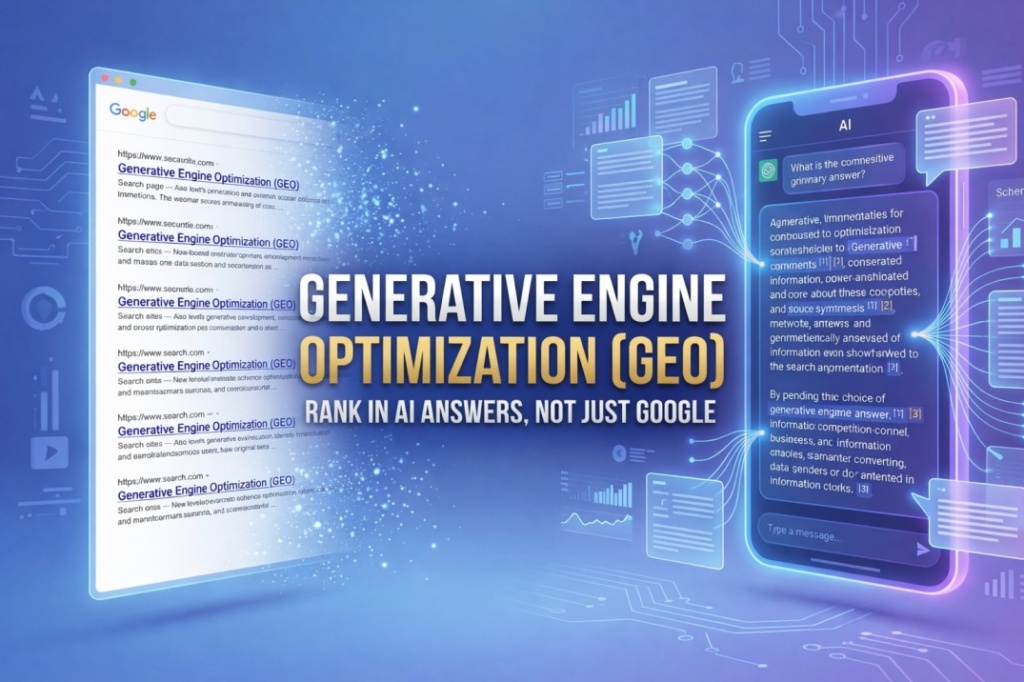
| Generative Engine Optimization (GEO) is the practice of structuring and optimizing digital content so it gets cited, referenced, or summarized by AI-powered search engines like Google AI Overviews, ChatGPT, Perplexity, and Gemini. Unlike traditional SEO — which targets search rankings — GEO targets AI-generated answers. The goal is to become part of the AI's response, not just a link beneath it. |
Introduction: The Search Landscape Has Changed
A few years ago, ranking #1 on Google was the holy grail of digital marketing. Today, that is no longer enough. When users type a question into Google, ChatGPT, or Perplexity, they often never see your blue link — they receive a fully synthesized AI-generated answer. Your content either contributed to that answer, or it was invisible.
This shift has given birth to a new discipline: Generative Engine Optimization (GEO). If you have been asking 'what is generative engine optimization?' or wondering how to show up in AI search results, this guide covers everything — from the core definition to actionable strategies, measurable tactics, and real-world examples.
By the end of this guide you will understand:
- What GEO is and why it matters
- How GEO differs from SEO and AEO (Answer Engine Optimization)
- The exact strategies and content techniques that get you cited by AI
- How to measure your GEO performance
- Common mistakes and how to avoid them
1. What Is Generative Engine Optimization (GEO)
| Generative Engine Optimization (GEO) is the discipline of creating, structuring, and presenting content in ways that make it discoverable, extractable, and citable by large language models (LLMs) and AI-powered search engines. GEO focuses on ensuring your brand, data, and insights appear inside AI-generated responses — not just in traditional search result lists. |
GEO operates at the intersection of content strategy, technical optimization, and brand authority building. It recognizes that AI engines — unlike traditional search algorithms — do not simply rank pages; they synthesize, summarize, and recommend content by pulling from multiple trusted sources.
The term was first formally studied in a 2023 Princeton, Georgia Tech, IIT Delhi, and Allen AI research paper titled 'GEO: Generative Engine Optimization,' which analyzed how different content strategies affected citation rates in AI-generated responses.
Key Terms and Concepts in GEO
| Term | Definition | Why It Matters for GEO |
| Large Language Model (LLM) | AI system trained on massive text data to generate human-like responses | LLMs are the engine behind ChatGPT, Gemini, and Perplexity — the platforms your content must influence |
| AI Overviews (AIO) | Google's AI-generated summaries at the top of search results | AIO reduces click-through rates by 34.5% — your content must be inside the answer |
| Answer Engine Optimization (AEO) | Optimizing for voice and AI-answer platforms | Closely related to GEO; both prioritize structured, factual, question-answering content |
| Entity | A real-world object, person, brand, or concept recognized by AI | Strong entity recognition improves AI's ability to trust and cite your brand |
| Semantic SEO | Optimizing for meaning and topic clusters, not just keywords | Foundational to both SEO and GEO — AI rewards topical authority |
| Citation Optimization | Making content easy for AI to reference and attribute | Core GEO tactic: structured data, clear authorship, and factual accuracy drive citations |
2. GEO vs SEO vs AEO: What Is the Difference?
Understanding the differences between GEO, traditional SEO, and Answer Engine Optimization (AEO) is critical before building your strategy. Many marketers mistakenly treat these as interchangeable — they are not.
Side-by-Side Comparison
| Factor | Traditional SEO | GEO (Generative Engine Optimization) |
| Primary Goal | Rank high in search result pages (SERPs) | Get cited inside AI-generated answers |
| Key Platforms | Google, Bing, Yahoo | ChatGPT, Perplexity, Google AI Overviews, Gemini |
| Success Metric | Keyword rankings, organic traffic, CTR | Brand mentions in AI, citation frequency, AI share of voice |
| Content Format | Keyword-rich long-form, meta tags, backlinks | Structured, factual, question-answering, entity-clear |
| Algorithm | Crawling, indexing, ranking signals | LLM training data, RAG retrieval, trust signals |
| Link Building | Critical — backlinks drive authority | Important but unlinked brand mentions also carry weight |
| Keyword Role | Core to page targeting | Secondary — semantic meaning and intent matter more |
| CTR Impact | Higher ranking = higher CTR | AI answers reduce CTR; presence in answer = brand awareness |
| Freshness | Important for time-sensitive topics | Critical — AI systems favour recent, updated, verified content |
Do GEO and SEO Work Together?
Yes — and separating them is a strategic mistake. The strongest GEO performers are brands with deep SEO foundations: topical authority, high-quality backlinks, structured content, and technical accessibility. GEO amplifies what good SEO has already built. Think of SEO as getting your content indexed and ranked; GEO is what gets that content cited by AI.
Microsoft's official generative search guidelines reinforce this: make content machine-readable, answer real questions, and build authority through credible sourcing — the same pillars that have driven traditional SEO for two decades.
3. Why Does GEO Matter? Key Stats and Business Impact
The shift toward AI-generated search is not theoretical — it is measurable and accelerating. Here is why GEO deserves immediate strategic attention.
AI Search Growth: The Numbers
| Metric | Data Point / Source |
| ChatGPT Weekly Active Users | 800+ million (as of early 2026) |
| Google Gemini Monthly Users | 750+ million (as of 2026) |
| Google AI Overviews Frequency | Appears in 16%+ of all Google searches |
| CTR Drop with AI Overview | 34.5% lower average CTR vs. results without AI Overview (Ahrefs) |
| AI Overview Citation Volatility | 40-60% of cited sources change month to month (Semrush) |
| Perplexity Daily Queries | Hundreds of millions of queries processed monthly |
| ChatGPT as a Referral Source | Became #1 referral source for bootstrapped SaaS tool Tally |
Business Impact of GEO
- Brand Discovery: AI mentions expose your brand to users who may never click organic results
- Qualified Traffic: Visitors arriving from AI citations are typically high-intent and research-ready
- Always-On Visibility: AI systems operate 24/7 and reference content continuously
- Competitive Moat: Early GEO adopters establish authority harder to displace than keyword rankings
- Reduced Dependency on Paid Ads: Organic AI mentions are earned, not bought
4. How Does Generative Engine Optimization Work? (The Mechanics)
How AI Search Engines Retrieve and Cite Content
To optimize for AI engines, you must first understand how they process information. Unlike traditional search engines that crawl and index pages, generative AI systems work through two primary mechanisms:
Mechanism 1 - Training Data
LLMs like GPT-4 and Gemini are trained on enormous datasets pulled from the internet, books, academic papers, and curated sources. Content that was widely available, well-structured, and frequently cited during training has a higher probability of appearing in model outputs. This is why established, authoritative domains are more likely to be referenced.
Mechanism 2 - Retrieval-Augmented Generation (RAG)
Modern AI search engines like Perplexity and Google AI Overviews use RAG — they retrieve live web content at query time and then generate a synthesized answer grounded in that retrieved information. For RAG-based systems, real-time content quality, freshness, and structural clarity are critical ranking signals.
What Signals Do AI Engines Trust?
| Trust Signal | How to Implement It |
| Entity Clarity | Use your brand name, author names, and topic entities consistently across all content and schema markup |
| Factual Accuracy | Every claim should be sourceable; link to primary research, official reports, and government data |
| Structural Extractability | Use clear H1-H4 hierarchy, definition boxes, FAQ sections, numbered lists, and tables |
| Author Credibility | Add structured author bio pages with credentials, social profiles, and publication history |
| Content Freshness | Update high-performing pages at least quarterly; add 'Last Updated' dates visibly |
| Topical Authority | Build content clusters around your core topics — AI rewards depth over breadth |
| Unlinked Brand Mentions | Earn citations in industry media, forums, and social without needing a backlink |
| Structured Data / Schema | Implement Article, FAQPage, HowTo, and Person schema to help AI parse your content |
| Multi-Platform Presence | Your brand should appear consistently on LinkedIn, Wikipedia, YouTube, Reddit, and industry publications |
5. Generative Engine Optimization Strategies: A Complete Framework
The following strategies are organized from foundational to advanced, covering both content and technical dimensions of GEO.
Strategy 1 - Build Topical Authority Through Content Clusters
AI systems are more likely to cite brands that demonstrate deep expertise on a topic — not just a single article. Build interlinked content clusters where a main pillar page (like this one) is supported by detailed subtopic articles.
- Create a pillar page for your primary topic (e.g., 'Complete Guide to GEO')
- Support it with 8-15 cluster articles covering subtopics in depth
- Internally link all cluster articles back to the pillar page
- Update the pillar page quarterly to reflect new developments
- Use consistent terminology across all cluster content to reinforce entity associations
Strategy 2 - Optimize Content for AI Extractability
AI engines need to quickly extract clean, reliable answers from your content. Every page should be built to make extraction effortless.
- Open every major section with a 40-60 word direct answer paragraph
- Use H2 and H3 headings formatted as questions (e.g., 'What is GEO?', 'How does GEO work?')
- Create definition boxes for all key terms
- Use numbered lists for processes and bullet lists for features
- Place your most important claims in the first 100 words of each section
- Avoid jargon without explanation — AI rewards clarity
Strategy 3 - Use Long-Tail, Conversational, Question-Based Keywords
Generative engines are optimized for natural language queries. Users ask full questions, not keyword fragments. Your content must reflect this conversational pattern.
LSI and Semantic Keywords to Target Alongside GEO
| Primary / LSI Keyword | Content Placement Suggestion |
| What is generative engine optimization | H1 title, first paragraph, FAQ section |
| GEO vs SEO | Dedicated H2 section with comparison table |
| AI search optimization | Throughout body copy; use in image alt text |
| How to rank in AI answers | HowTo structured section (Step 1, Step 2...) |
| Answer engine optimization | GEO vs AEO comparison table |
| LLM visibility strategy | Advanced strategies section |
| How to appear in ChatGPT answers | Dedicated H3 or FAQ answer |
| Google AI Overviews optimization | Technical optimization section |
| Perplexity SEO | Platform-specific tactics section |
| AI citation optimization | Core GEO mechanics section |
| Generative AI content strategy | Introduction and strategy sections |
| Structured data for AI search | Technical GEO section |
| Featured snippet optimization | AI extractability strategy section |
| Topical authority for AI | Content cluster strategy section |
Strategy 4 - Earn Multi-Platform Brand Mentions
AI systems build trust in a brand through the totality of its web presence — not just its own website. Unlinked brand mentions in credible publications are weighted signals in AI retrieval.
- Publish guest posts or expert commentary on high-DA industry publications
- Pursue PR coverage in trade media, news outlets, and niche blogs
- Maintain active, consistent profiles on LinkedIn, Reddit, YouTube, and Quora
- Get featured in roundup articles, 'best of' lists, and comparison guides
- Ensure your Wikipedia presence (if applicable) is accurate and up to date
- Submit to industry directories, award lists, and academic citation databases
Strategy 5 - Implement Comprehensive Schema Markup
Schema markup is machine-readable metadata that tells AI systems exactly what your content is about, who wrote it, and why it should be trusted.
- Article schema: author, date published, date modified, headline, publisher
- FAQPage schema: each FAQ question and answer pair
- HowTo schema: step-by-step processes with named steps
- Person schema: author credentials, affiliations, social profiles
- Organization schema: brand name, logo, founded date, social profiles
- BreadcrumbList schema: site structure and content hierarchy
Strategy 6 - Prioritize Content Freshness and Accuracy
AI systems — especially RAG-powered ones — heavily favour content that is current, accurate, and verifiable. Stale content with outdated statistics is actively deprioritized.
- Add a visible 'Last Updated' date to all key pages
- Review and refresh high-value pages every 90 days
- Replace outdated statistics with the most recent available data
- Add a 'Content Review Policy' or 'Editorial Standards' page to build trust signals
- Correct factual errors immediately when identified
6. How to Implement GEO: Step-by-Step Action Plan
Use this HowTo framework to implement GEO systematically. Each step is schema-ready for HowTo structured data markup.
| Step | Action |
| Step 1 - Audit Your Current AI Visibility | Use tools like Semrush AI Toolkit, Brandwatch, or manual testing to check if your brand appears in ChatGPT, Perplexity, and Google AI Overview responses for your key topics. |
| Step 2 - Define Your Topic Authority Zones | List the 3-5 core topics your brand should own. Build a content cluster strategy around each topic with a pillar page and 8+ supporting articles. |
| Step 3 - Reformat Existing Content for Extractability | Add quick answer boxes, definition sections, numbered processes, comparison tables, and FAQ sections to your highest-traffic existing pages. |
| Step 4 - Implement Schema Markup | Add Article, FAQPage, HowTo, and Person schema to all key pages. Use Google's Rich Results Test to validate. |
| Step 5 - Build Multi-Platform Brand Signals | Publish on industry sites, engage on LinkedIn and Reddit, pursue PR mentions, and contribute to podcasts and video content. |
| Step 6 - Optimize Technical Accessibility | Ensure AI crawlers can access your content: fix robots.txt blocks, improve page speed, use clean HTML structures, and maintain an accurate sitemap. |
| Step 7 - Monitor AI Citations and Mentions | Track your AI visibility monthly using Semrush AIO, Brandwatch, or by manually querying AI platforms for your target topics and brand name. |
| Step 8 - Iterate and Expand | Identify which content gets cited most frequently and create more in the same format. Double down on what AI engines reward. |
7. Platform-Specific GEO: ChatGPT, Perplexity, Google AI Overviews
While core GEO principles apply across platforms, each AI engine has unique retrieval characteristics. Understanding platform nuances gives you an edge.
Google AI Overviews (AIO)
- Prioritizes pages that already rank on page 1 of Google — strong traditional SEO remains foundational
- Favours content with clear definitions, lists, and tables that can be cleanly extracted
- Rewards E-E-A-T signals: author credentials, site reputation, accurate citations
- Use structured data markup to increase extractability
- Conversational, question-answering content is heavily favoured
ChatGPT (with Browse / GPT-4o)
- Relies on training data and live web browsing (Bing index) for real-time queries
- Well-established, authoritative domains cited consistently in training data hold advantage
- Clear, factual, well-sourced content is preferred — hedging and opinion without evidence is deprioritized
- Unlinked brand mentions across the web cumulatively influence model outputs
- Structured content with named entities and clear context improves citation probability
Perplexity AI
- Heavily RAG-based: retrieves live web content at query time and synthesizes an answer
- Freshness is critical — recently published or updated content has a clear advantage
- Sites with strong domain authority and structured content are retrieved more often
- Multimedia content (images, video transcripts) can be incorporated into responses
- Answering questions with specific, verifiable facts outperforms vague opinion content
Gemini (Google)
- Deeply integrated with Google's search index — strong SEO and GEO overlap
- Rewards content from Google's trusted publisher network (Google News, verified authors)
- Structured data and authoritative linking are key signals
- Multimodal content (text + image) can be retrieved and cited
8. Pros and Cons of Generative Engine Optimization
| Dimension | Pros | Cons / Challenges |
| Visibility | Brand appears inside AI answers seen by millions of users | AI citations are volatile — 40-60% of sources rotate monthly |
| Traffic | Drives high-intent qualified visitors back to your site | AI answers reduce direct CTR; some users never visit your site |
| Authority | Being cited by AI builds significant brand credibility | Requires sustained effort — no quick-win shortcuts exist |
| Cost | Organic visibility — no direct cost per mention | Content production, schema, and outreach require significant investment |
| Measurement | New tools (Semrush AIO, Brandwatch) enable tracking | Measurement is less mature than traditional SEO analytics |
| Longevity | Well-structured content pays dividends long-term | AI platforms evolve rapidly — strategies may need frequent adjustment |
9. GEO Tools and Measurement
How to Measure GEO Performance
GEO metrics differ from SEO metrics. Track the following KPIs:
- AI Citation Frequency: How often your brand appears in AI-generated responses for target topics
- Share of Voice in AI: Your brand's presence compared to competitors in AI answers
- AI Referral Traffic: Sessions originating from AI platforms (trackable in GA4 with UTM attribution)
- Brand Sentiment in AI: Whether AI mentions your brand positively, neutrally, or negatively
- Featured in AI Overview: Presence in Google AI Overview for your target keywords
Recommended GEO Tools
| Tool | Primary Use Case | Pricing Tier |
| Semrush AI Toolkit / AIO | Track AI share of voice, brand mentions, AI rankings | Enterprise / Paid |
| Brandwatch | Monitor brand mentions across AI platforms and web | Enterprise / Paid |
| Perplexity AI (manual) | Test your brand's appearance for target queries | Free / Pro |
| ChatGPT (manual testing) | Check how ChatGPT represents your brand and content | Free / Plus |
| Google Search Console | Track traditional SEO performance (foundational for GEO) | Free |
| Google Rich Results Test | Validate schema markup for structured data | Free |
| Ahrefs / Semrush | Topical authority analysis, backlink building, content gaps | Paid |
10. Common GEO Mistakes to Avoid
| Mistake | Why It Hurts and How to Fix It |
| Treating GEO as Separate from SEO | GEO and SEO are deeply interconnected. Fix: Integrate GEO tactics into your existing SEO content strategy, not as a separate workstream. |
| Ignoring Content Structure | AI cannot easily extract value from walls of unformatted text. Fix: Use H2/H3 hierarchies, definition boxes, tables, and FAQs on every page. |
| Publishing Without Schema | Missing schema markup reduces AI's ability to understand and trust your content. Fix: Implement Article, FAQPage, and HowTo schema on all key pages. |
| Neglecting Brand Mentions Off-Site | Your own website alone is insufficient. Fix: Pursue PR, guest posting, and social media activity to build multi-platform brand signals. |
| Failing to Update Content | Stale content is deprioritized by RAG-based AI systems. Fix: Set quarterly content review cycles and update statistics and insights regularly. |
| Optimizing Only for One AI Platform | Different AI systems have different retrieval mechanisms. Fix: Build content that is broadly structured for extractability across all major platforms. |
| No GEO Measurement in Place | You cannot optimize what you do not measure. Fix: Implement AI visibility tracking tools alongside your existing SEO analytics. |
11. GEO Optimization Checklist
Use this checklist before publishing or updating any page targeting AI visibility:
Content Structure
- Quick Answer / Definition box at the top (40-60 words)
- H1 includes primary keyword naturally
- H2 and H3 headings formatted as questions where applicable
- Definition boxes for all key terms
- At least one comparison table per major section
- FAQ section with 5-8 questions and direct answers
- Numbered lists for processes; bullet lists for features
- 'Last Updated' date visible on the page
Technical GEO
- Article schema implemented and validated
- FAQPage schema added for all FAQ questions
- HowTo schema for step-by-step sections
- Person / Author schema on author bio page
- Page accessible to AI crawlers (check robots.txt)
- Page load speed under 3 seconds
- Canonical URL set correctly
12. Frequently Asked Questions About GEO
Q1: What is Generative Engine Optimization in simple terms?
| Generative Engine Optimization (GEO) is the practice of making your content so well-structured, factual, and authoritative that AI-powered engines like ChatGPT, Perplexity, and Google AI Overviews include it in their generated answers. Instead of just ranking on a results page, your content becomes part of the AI's response itself. |
Q2: Is GEO replacing SEO?
| No — GEO builds on SEO rather than replacing it. Traditional SEO remains critical for organic rankings and forms the foundation that GEO requires: topical authority, high-quality content, technical accessibility, and authoritative backlinks. The brands winning at GEO are typically those with strong SEO fundamentals who then layer on AI-specific optimization tactics. |
Q3: How long does GEO take to show results?
| GEO results typically take 3-6 months of consistent effort to become measurable, similar to SEO timelines. Initial improvements — such as your content being cited in AI responses — may appear within 4-8 weeks of implementing structured content, schema markup, and multi-platform brand building. Long-term topical authority takes 6-12+ months to establish. |
Q4: Which AI platforms should I prioritize for GEO?
| Prioritize Google AI Overviews first (highest search volume and traffic impact), followed by ChatGPT (800M+ weekly users), and Perplexity (fastest-growing AI search engine). Gemini is increasingly important given its deep Google Search integration. A well-structured, factual, and authoritative content strategy will perform well across all platforms. |
Q5: What content formats work best for GEO?
| The highest-performing GEO content formats are: (1) Definition and FAQ sections with direct answers, (2) numbered how-to guides, (3) comparison tables, (4) data-backed listicles, and (5) expert interviews and original research. The common thread is extractability — content that AI can easily pull, summarize, and attribute to your brand. |
Q6: Do I need to write separately for each AI platform?
| No. A single, well-structured piece of content optimized for clarity, factual accuracy, and extractability will perform across multiple AI platforms. Platform-specific nuances (such as Perplexity's preference for freshness or Google AIO's E-E-A-T signals) can be addressed through general best practices — updated content, schema markup, and authoritative sourcing — rather than platform-specific rewrites. |
Q7: How does GEO affect website traffic?
| GEO has a dual effect on traffic. Appearing inside AI-generated answers boosts brand awareness and drives highly qualified referral traffic from users who click through to learn more. However, AI answers also reduce click-through rates for traditional organic results — Ahrefs data shows a 34.5% CTR drop when an AI Overview is present. This makes GEO essential: if your content is not inside the AI answer, you lose visibility entirely. |
Q8: What is the difference between GEO and AEO (Answer Engine Optimization)?
| AEO (Answer Engine Optimization) focuses on optimizing content for voice search and FAQ-style answer boxes — a concept that emerged with Google's featured snippets and voice assistants. GEO is broader and more advanced: it encompasses all AI-generative platforms including ChatGPT, Perplexity, and Gemini. GEO includes AEO principles but extends them to address LLM-specific signals like entity clarity, RAG retrieval, and multi-platform brand authority. |
About us and this blog
We are a digital marketing company with a focus on helping our customers achieve great results across several key areas.
Request a free quote
We offer professional SEO services that help websites increase their organic search score drastically in order to compete for the highest rankings even when it comes to highly competitive keywords.
Subscribe to our newsletter!
More from our blog
See all posts