Quick Answer
SEO for franchises is the practice of optimizing a franchise brand's online presence at both the national (corporate) and local (per-location) level, so each location ranks in its own market without competing with other franchise locations. It combines technical site architecture, local SEO, Google Business Profile management, and content strategy at scale.
What Is SEO for Franchises? (And Why It's Different)
Franchise SEO is a multi-tiered search engine optimization strategy that builds brand-level authority through a single domain while simultaneously optimizing each individual franchise location for local search queries, map pack rankings, and geographic keywords, all without creating internal competition between locations.
If you've ever tried to apply standard local SEO tactics to a franchise network and found that some locations were mysteriously cannibalizing each other's rankings, you've experienced exactly why franchise SEO demands a different approach.
The fundamental challenge is this: you need each location to rank in its own city, while the brand as a whole ranks nationally. These goals are not automatically aligned. Without the right structure, your Denver location could be competing with your Colorado Springs location for the same queries, and both lose.
Franchise SEO vs. Regular Local SEO: Key Differences
The table below illustrates the core structural differences between managing SEO for a single location versus a franchise network:
| Dimension | Single Location | Franchise | Enterprise Multi-Location |
| Number of Locations | 1 | 10 to 1,000+ | 100 to 10,000+ |
| Governance | Owner decides all | Corporate vs. franchisee split | Centralized brand team |
| Cannibalization Risk | None | High | Very High |
| Technical Complexity | Low | Enterprise-level | Advanced enterprise |
| Reporting Structure | Simple dashboard | Per-location dashboards | Regional + global rollups |
| Content Strategy | Single audience | Brand + local hybrid | Multi-region, multi-language |
The difference is not just volume. It's governance, architecture, and coordination. A single-location business owner can make every SEO decision independently. A franchise brand must coordinate dozens or hundreds of decisions simultaneously, across locations with different operators, different markets, and different levels of digital maturity.
The Dual Goal of Franchise SEO: Brand Authority and Local Visibility
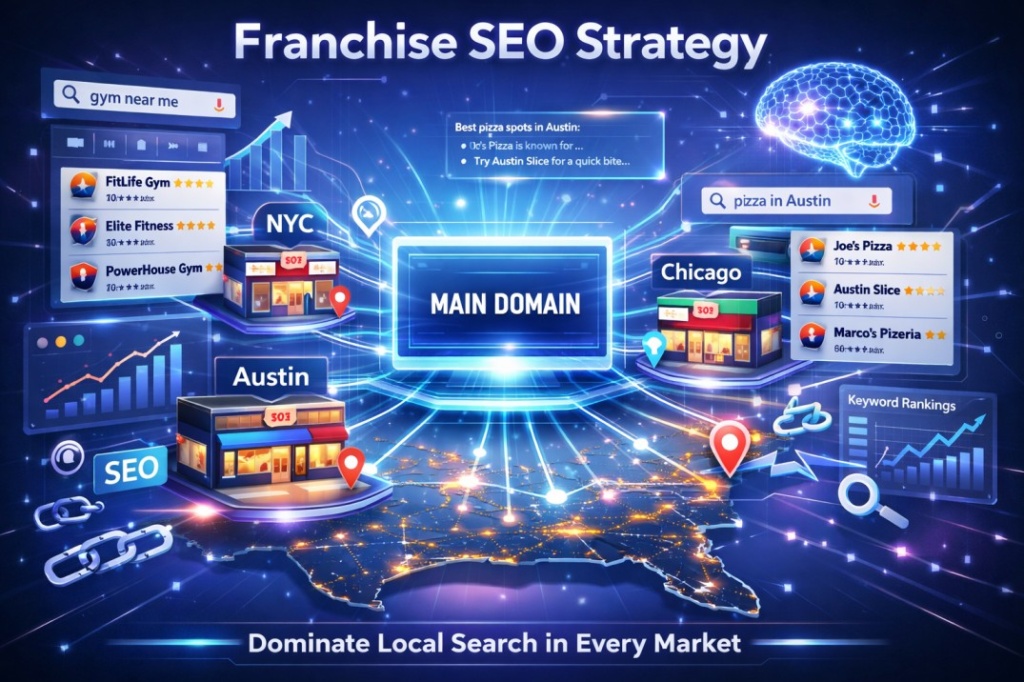
Think of your corporate domain as the mothership. It carries the brand's full authority, built up through backlinks, content, technical excellence, and years of trust signals. Every location page you add to that domain is a spoke extending from that hub, inheriting a share of that authority.
When you structure your franchise site correctly, a new location in a mid-sized city can rank faster than an independent competitor simply because it lives on a domain Google already trusts. This is one of the most powerful and underused advantages franchise brands have in local search.
The URL structure for this hub-and-spoke model looks like this: domain.com/locations/state/city-name. The corporate domain sits at the center, with state-level hub pages connecting to individual city location pages. Each location page inherits domain authority from above while building its own local relevance signals through content, reviews, and citations.
At Digital Web Magnate, we've helped franchise brands leverage their domain authority to launch new locations into competitive local markets within 60 to 90 days of going live. The architecture makes the difference.
How Google Ranks Franchise Locations in Local Search
Before you can optimize franchise locations for local search, you need to understand precisely how Google decides which location to show and when. This is not guesswork. Google follows a structured evaluation process, and knowing it changes how you build every part of your franchise SEO strategy.
Understanding the Local Pack (Map Pack) for Franchises
When someone types "pizza delivery near me" or "gym in Austin," Google returns a map pack: three business listings that appear above the organic results, complete with a map, reviews, hours, and a link to each business's Google Business Profile.
For franchise brands, this map pack is the most valuable real estate in local search. Appearing in the local pack for a city-level query can generate more calls, direction requests, and website visits than ranking in position one of the organic results.
The challenge unique to franchises is self-competition. If you have three locations within 15 miles of each other, Google may choose to show only one of them in the pack for a broad query, rotating between them or defaulting to the closest one. Without a clear local signal distinguishing each location, you're effectively competing against yourself.
Entity-Based SEO for Franchise Brands
Google no longer just matches keywords to pages. It understands businesses as entities, meaning Google builds a knowledge model of your brand that includes what you do, where you operate, who your customers are, and how you're talked about across the web.
For franchise brands, this means establishing two levels of entity: the brand entity at the corporate level and a unique local entity for each franchise location. The brand entity is built through consistent name, address, and phone information, structured data markup, Wikipedia or Wikidata presence, and national media coverage. Each local entity is built through location-specific GBP profiles, localized citations, local reviews, and community content.
When Google can cleanly separate each franchise location as a distinct local entity, it's far more likely to rank each location appropriately for its own geographic area rather than confusing them with one another.
The 3 Local Ranking Factors Google Uses for Franchise Locations
Google uses three core factors to determine which local businesses appear in the map pack:
- Relevance: How closely does the business match what the user is searching for? This is influenced by your GBP category, the services listed, the content on your location page, and the keywords in your reviews.
- Distance: How close is the business to the searcher's location, or the location they specified in the query? This is why a franchise location in downtown Denver should not target keywords for a suburb 20 miles away.
- Prominence: How well-known and trusted is this location? This includes review quantity and rating, the number of backlinks pointing to the location page, the completeness of the GBP profile, and engagement signals like calls and direction requests.
Consider a practical example. When someone searches "burger restaurant near me" in Phoenix, Google evaluates every nearby burger franchise location against these three factors simultaneously. The location with a complete GBP profile, 150+ positive reviews, and a well-optimized location page on a strong domain will consistently outperform the location with a sparse profile and 12 reviews, even if they're the same brand.
Franchise Website Architecture: The Foundation of Scalable SEO
The single most important technical decision you'll make for franchise SEO is your website architecture. Get this right, and every location benefits from the brand's domain authority. Get it wrong, and you're fighting an uphill battle that no amount of content or link building can fully compensate for.
Subdomain vs. Subdirectory vs. Microsites: Which Is Right for Franchises?
| Structure Type | Pros | Cons | Recommended For |
| Subdirectory (domain.com/locations/city/) | Full domain authority transfer. Easier to manage. Best for Google indexing. | Requires centralized CMS control. | Most franchise models. Gold standard in 2025. |
| Subdomain (city.domain.com) | Independent structure per location. Useful for franchisee autonomy. | Dilutes domain authority. Treated as separate sites by Google. | Rarely recommended. Use only if CMS demands it. |
| Separate Domains (cityfranchise.com) | Maximum franchisee independence. | Extremely hard to rank. No shared authority. High cost and complexity. | Master franchise international models only. |
The recommendation is clear: use subdirectories. Placing your location pages at domain.com/locations/city/ keeps all authority on a single root domain, simplifies crawling and indexing, and allows Google to clearly understand the relationship between your corporate site and each franchise location.
Many franchises inherited a subdomain structure years ago and are reluctant to migrate. In our experience, the migration is almost always worth it. The short-term ranking fluctuation during migration is recovered within three to six months, and the long-term authority consolidation is substantial.
URL Structure Best Practices for Multi-Location Franchises
Your URL structure tells Google and users exactly what a page is about before they even visit it. For franchise location pages, follow this hierarchy:
- Corporate: domain.com/locations/
- State Hub: domain.com/locations/texas/
- City Location: domain.com/locations/texas/austin/
- Service-Location Combo: domain.com/plumbing/austin-tx/ (for service-area businesses)
If you have multiple locations in the same city, differentiate by neighborhood: domain.com/locations/texas/austin/south-congress/ and domain.com/locations/texas/austin/north-loop/. Avoid generic differentiators like "austin-1" or "austin-main" that add no geographic or SEO value.
Internal Linking Architecture for Franchise Sites
Authority flows through internal links the same way water flows through pipes: from the strongest source to the pages that need it most. For franchise sites, this means building a clear hierarchy:
- The corporate homepage links to a main locations directory page.
- The locations directory links to state hub pages.
- State hub pages link to individual city location pages.
- Each location page links back to the state hub and includes contextual links to relevant service pages.
Avoid creating location pages that exist in isolation with no internal links pointing to them. These orphan pages are difficult for Google to find and index, and they receive none of the domain authority that makes franchise SEO so powerful in the first place.
Technical SEO Checklist for Franchise Websites
- XML Sitemaps: Create a segmented sitemap. One sitemap for corporate pages and one for location pages. This makes crawling efficient at scale.
- Canonical Tags: Every location page should have a self-referencing canonical tag. If you have service-location combo pages that overlap in topic, use canonicals to designate the primary page.
- Hreflang: If you operate in multiple countries or in both English and Spanish markets, implement hreflang tags to serve the correct version to the correct audience.
- Site Speed at Scale: Use a CDN (Content Delivery Network) to ensure location pages load quickly regardless of where the user is located. Monitor Core Web Vitals per location page, not just the homepage.
- Schema Markup: Implement LocalBusiness schema on every location page, Organization schema on the corporate site, and BreadcrumbList schema to reflect the URL hierarchy.
Local SEO for Franchises: How to Rank in Every Market You Operate In
Architecture sets the foundation. Local SEO builds the house. This section covers the four pillars of local franchise SEO: keyword strategy, location page creation, Google Business Profile management, and NAP consistency.
Keyword Strategy for Franchise Local SEO
Franchise SEO keyword strategy operates on three tiers, and confusing these tiers is one of the most common mistakes we see:
Corporate Tier: Branded keywords ("[Franchise Name]"), national industry terms ("best [franchise type] franchise"), and franchise development terms ("buy a [franchise name] franchise"). These live on the corporate site.
Regional Hub Tier: State-level or metro-level terms ("[service] in Texas", "[franchise name] in the Dallas-Fort Worth area"). These live on state or regional hub pages.
Local Location Tier: City-specific queries ("[service] in Austin", "[franchise name] Austin TX", "[service] near me"). These live exclusively on individual location pages.
Build a keyword map before you create any content. Each location page should own a distinct set of city-specific keywords. No two location pages should target the same terms. This is the foundation of cannibalization prevention.
How to Build Location Pages That Actually Rank
The average franchise location page is a thin template with a swapped city name and a copied description. Google's helpful content system has become increasingly effective at identifying this type of content, and it is not rewarded in rankings.
Here are the ten elements every franchise location page must have:
| Location Page Element | Priority Level | Implementation Notes |
| Unique Page Title with City + Service | Critical | Format: [Service] in [City] | [Brand Name] |
| LocalBusiness Schema (JSON-LD) | Critical | Include NAP, hours, geo-coordinates, service type |
| Unique Location-Specific Content | Critical | Minimum 400 words. No copy-paste from other locations. |
| Embedded Google Map | High | Embed map of exact location. Boosts local relevance signals. |
| Local Phone Number (Click-to-Call) | High | Use location-specific number, not a national redirect. |
| Customer Reviews (Local) | High | Display Google or platform reviews specific to that location. |
| Local Team Bios or Staff Photos | Medium | Humanizes the location. Strong EEAT signal. |
| Community Involvement Content | Medium | Sponsorships, events, local partnerships. Builds local authority. |
| FAQs Based on Local Search Queries | Medium | Answer city-specific questions. Use FAQPage schema. |
| Clear CTA with Location-Specific Offer | High | Drive conversions. Tailor the offer to local market. |
The most underestimated element on this list is unique local content. This does not mean writing a 2,000-word essay for every location. It means ensuring that each location page contains content that genuinely reflects that specific location: the neighborhood it serves, the team that works there, the community events it participates in, and the specific customer concerns most relevant to that market.
Google Business Profile (GBP) Management at Scale
Your Google Business Profile is often the first thing a potential customer sees when they search for your franchise location. It appears in the map pack, in direct brand searches, and increasingly as a source for Google's AI Overview answers. Optimizing it thoroughly is non-negotiable.
Key GBP optimization areas for franchises:
- Ownership and Governance: Decide upfront whether the franchisor or franchisee owns and manages each GBP profile. We recommend franchisor ownership with franchisee access as a manager. This prevents rogue edits while allowing local updates.
- Categories and Services: Select the most specific primary category available. Add all relevant secondary categories. Complete the services section thoroughly, as this content directly influences what queries trigger your listing.
- Attributes: Fill in every applicable attribute (Wi-Fi available, wheelchair accessible, women-led, etc.). These attributes appear in search results and influence relevance scoring.
- GBP Posts: Publish posts at least twice per month per location. Include a mix of offers, updates, and event announcements. Posts are a freshness signal that Google's local algorithm uses.
- Photos: Maintain a minimum of 25 photos per location. Update with fresh photos regularly. Locations with more photos receive significantly more clicks and direction requests.
- Bulk Management: For networks of 10+ locations, use Google Business Profile Manager's bulk upload feature (CSV upload) to update hours, attributes, and categories simultaneously. This saves significant time at scale.
If you're managing 50 or more franchise locations and struggling with GBP consistency, our team at Digital Web Magnate specializes in multi-location profile audits and optimization at scale.
NAP Consistency Across All Franchise Locations
NAP stands for Name, Address, and Phone number. Consistency of this information across your website, GBP profiles, and every directory listing where your franchise locations appear is a foundational local ranking signal.
A franchise with locations in 30 cities that has slightly different address formats in different directories ("Suite 100" vs. "Ste. 100" vs. "#100") is sending conflicting signals to Google. Over 30 locations, these inconsistencies add up significantly.
Tools for auditing NAP across your franchise network include BrightLocal (excellent for multi-location citation tracking), Moz Local, and Yext (useful for bulk citation distribution and updates). For new locations, build citations in the right format from day one. Correcting existing inconsistencies across a large network is a significant investment of time and resources.
Preventing Keyword Cannibalization Between Franchise Locations
Definition: Keyword cannibalization in franchise SEO occurs when two or more franchise location pages target the same keywords, causing Google to split ranking signals between them. The result is both pages ranking lower than a single well-optimized page would have achieved on its own.
Cannibalization is the most underdiagnosed problem in franchise SEO. In our audit of a 40-location franchise client, we found 23 pairs of competing location pages targeting the same city-level queries. After implementing a proper keyword segmentation framework, average position for target terms improved from position 8 to position 3 within 90 days. The pages hadn't been changed. The competition between them had simply been resolved.
How to Detect Cannibalization Across Franchise Locations
Detecting cannibalization requires a systematic audit, not a quick check:
- Google Search Console: In the Performance report, filter by a target keyword. If multiple location pages are appearing for the same query, cannibalization is confirmed.
- Screaming Frog and Ahrefs Workflow: Crawl the site with Screaming Frog to extract all location page URLs and their title tags. Import into Ahrefs and review which pages rank for overlapping keywords.
- Warning Signs: Two location pages for adjacent cities both appearing on page two of results for the same term when one should be on page one. Click-through rate declining despite stable rankings.
Keyword Segmentation Framework for Franchise Networks
- Corporate Domain: Brand-level terms ("[Franchise Name]"), franchise opportunity terms ("own a [franchise name] franchise"), and broad industry leadership content.
- State Hub Pages: State-level modifier queries ("[service] in Texas", "top [franchise type] in California").
- City Location Pages: City-specific queries only ("[service] in [city]", "[franchise name] [city]", "[service] near [landmark]").
- Neighborhood Pages (when warranted): Hyper-local long-tail queries for high-density markets where multiple neighborhoods have distinct search behavior.
The Geo-Fence Content Strategy
The solution to location page duplication is geographic differentiation in content, not just geographic names. Swapping one city name for another across otherwise identical pages does not make those pages unique in Google's eyes.
A genuine geo-fenced location page includes:
- References to actual local landmarks, neighborhoods, and areas served ("We serve customers across Capitol Hill, SoDo, and Beacon Hill").
- Community involvement specific to that location (local sponsorships, events attended, charities supported).
- FAQ sections that reflect the actual questions people in that specific market are searching for, based on local keyword research.
- Testimonials and reviews from customers in that city, not a generic review feed.
This approach creates location pages that are meaningfully distinct in content even when they cover the same service category. Google's algorithms reward this. More importantly, local customers respond to it.
Reputation Management and Reviews: The Local Trust Signal Google Cannot Ignore
Why Reviews Are a Direct Franchise SEO Ranking Factor
Reviews are one of the most powerful local ranking signals available to franchise brands, and they're almost entirely controlled at the franchisee level. This makes review strategy a critical governance issue as much as a marketing issue.
Consumer research from BrightLocal consistently shows that the overwhelming majority of consumers read online reviews before visiting a local business. For franchise locations, a strong review profile achieves two outcomes simultaneously: it improves local pack ranking and it converts searchers into customers. Data from the Whitespark Local Ranking Factors report confirms that review signals, including quantity, velocity, rating, and owner response rate, are among the top factors influencing local pack placement.
Building a Scalable Review Generation System for Franchise Networks
The franchises that generate reviews consistently are not relying on customers to volunteer them spontaneously. They have systematic processes in place:
- In-Location QR Codes: Place review request QR codes at checkout counters, reception desks, or service completion points. Linking directly to the Google review form removes friction.
- Post-Service Email and SMS Requests: Automated emails or text messages sent 24 to 48 hours after a service is completed, with a direct link to leave a Google review. Timing matters: requests sent too quickly or too long after the service see significantly lower conversion rates.
- Platform Priority by Vertical: Not every franchise vertical benefits equally from the same review platforms. Google Business Profile is the universal priority, but secondary platforms vary by industry.
| Industry | Top Review Platform | Secondary Platform | Review Velocity Target |
| Food and Restaurant | Google Business Profile | Yelp / TripAdvisor | 10+ reviews/month per location |
| Fitness and Gym | Google Business Profile | Yelp / Facebook | 5 to 8 reviews/month |
| Home Services | Google Business Profile | HomeAdvisor / BBB | 4 to 6 reviews/month |
| Healthcare and Wellness | Google Business Profile | Healthgrades / Zocdoc | 3 to 5 reviews/month |
| Retail | Google Business Profile | Yelp / Facebook | 6 to 10 reviews/month |
Responding to Reviews at Scale: Brand Voice and Local Personalization
Responding to reviews is a ranking signal, not just a courtesy. Franchises that respond to reviews consistently signal to Google that the location is actively managed, which contributes to prominence scoring.
For negative reviews, follow this framework: acknowledge the specific issue without being defensive, apologize sincerely, offer to resolve the matter offline, and provide a direct contact method. Never argue in a public review response. One poorly handled negative response, visible to every future searcher who sees your GBP profile, can undo significant positive momentum.
Create brand-approved response templates that maintain a consistent brand voice while leaving space for local personalization. A response that references the customer's specific experience or location feels authentic. A copy-pasted generic response does not.
The Franchisor vs. Franchisee SEO Responsibility Matrix
In franchise SEO, the franchisor controls the centralized architecture, including website structure, templates, technical SEO, and brand content. Franchisees own the local signals: Google Business Profile management, reviews, local citations, and community engagement. Both must operate within a coordinated governance model to avoid duplicating or undermining each other's efforts.
In our work with franchise brands across more than ten industries, the most common failure point is the absence of a governance model. Franchisees optimize independently, create canonical conflicts, build citations with inconsistent NAP formats, and sometimes build separate websites entirely. The resulting SEO chaos is expensive and time-consuming to untangle.
| SEO Task | Franchisor Responsibility | Franchisee Responsibility | Shared |
| Website Architecture and CMS | Owns and controls fully | None | |
| Technical SEO and Core Web Vitals | Implements across all pages | Reports local issues | Monitoring |
| Schema Markup | Templates corporate-level schema | Validates location schema | Implementation |
| National Link Acquisition | Manages PR and outreach | None | |
| Google Business Profile Setup | Creates and verifies | Manages day-to-day | Both |
| GBP Posts and Updates | Brand campaigns | Local events and offers | Both |
| Review Generation | Provides templates and strategy | Executes locally | Both |
| Local Citation Building | Sets standards | Builds local citations | Both |
| Location Page Content | Provides brand template | Adds local content layer | Both |
| SEO Reporting | Corporate dashboards | Location-level metrics | Both |
| Local Link Building | Brand-level outreach | Community outreach | Both |
| Brand Content and Blogging | Manages fully | Contributes local stories | Optional |
What the Franchisor Must Control Centrally
- Website architecture, hosting, and CMS platform selection.
- Technical SEO: schema markup templates, canonical tags, XML sitemaps, Core Web Vitals monitoring.
- Brand content templates: location page structure, brand voice guidelines, approved messaging.
- National PR and link acquisition campaigns that benefit all locations simultaneously.
- SEO training and onboarding materials for new franchisees joining the network.
What Franchisees Should Own Locally
- Google Business Profile day-to-day management: updating hours, posting updates, responding to reviews.
- Local review generation: executing the review request process the franchisor provides.
- Local citations: building presence in city-specific and industry-specific directories.
- Community-based content: local events attended, sponsorships, charity partnerships.
- Localized social media activity that complements the national brand presence.
Building SEO Governance Into Your Franchise Operations Manual
The franchise operations manual is the right place to document SEO responsibilities, not a separate marketing memo that gets ignored six months after launch. Include:
- An SEO onboarding checklist for new franchise locations covering GBP setup, citation building, and location page content submission.
- A monthly reporting cadence defining what each franchisee tracks and reports to corporate.
- Clear escalation procedures for franchisees who identify SEO issues with their location page.
- A defined protocol for handling franchisees who deviate from brand SEO standards, such as creating unauthorized microsites or modifying GBP categories without approval.
If you want to build a franchise SEO governance framework that your team can actually implement and maintain, Digital Web Magnate offers franchise SEO consulting and governance audits tailored to your network size and structure.
Content Marketing Strategy for Franchise SEO
The 3-Layer Content Model for Franchise Brands
Effective franchise content strategy is not about producing content randomly at each location level. It requires a deliberate three-layer architecture:
Layer 1 (Corporate Content): Brand authority, franchise development, industry leadership, and national trend content. Audience: potential franchisees, investors, journalists. Goal: establish the brand as the authority in its category.
Layer 2 (Regional Hub Content): State or metro-level content targeting regional service queries. Examples: "Best [service] providers in Texas" or "[Franchise Name] locations across the Southeast." Goal: capture regional traffic and funnel it to location pages.
Layer 3 (Local Content): Location-specific blogs, local event announcements, community spotlights, and neighborhood guides. Goal: establish each location as genuinely connected to its local community, earning local links and building local authority.
The proportion of content produced at each layer should reflect where your traffic opportunities are. Most franchise brands underinvest in Layer 3, relying on location pages alone to carry all local SEO weight. Adding even a modest volume of locally relevant blog content per location can meaningfully improve rankings over 6 to 12 months.
AI-Assisted Content Scaling for Franchises (Without Getting Penalized)
AI content tools have become genuinely useful for franchise SEO content production at scale. Used correctly, they can accelerate the creation of location page drafts, FAQ content, review response templates, and local blog outlines in a fraction of the time manual writing would require.
Used incorrectly, AI content triggers Google's helpful content system and results in ranking suppression that can affect an entire domain, not just the offending pages.
The approach that works follows a 60/40 model: 60% template content covering the universal service offering, brand standards, and core value propositions. 40% unique local content covering the specific market, community, team, and local context. The 60% can be AI-assisted. The 40% must be written or reviewed by someone with actual knowledge of that location.
The human review layer is not optional. A local reviewer catches inaccuracies, adds genuine local references, and ensures the content reflects the real experience of a customer in that market. AI alone cannot do this.
Blog and FAQ Content Strategy for Franchise Locations
FAQ content is one of the highest-leverage content investments for franchise SEO in 2025, for two reasons: it directly targets conversational search queries, and it is the format most frequently cited by Google AI Overviews and LLM-based search platforms like Perplexity.
Structure your FAQ content with direct, concise answers of 40 to 60 words per question. Begin each answer with a definition-style sentence that directly addresses the question without preamble. This format is not just good for SEO. It's how AI models extract and surface information when answering user queries.
Identify FAQ topics through Google's People Also Ask boxes for your target keywords, Search Console queries that return FAQ-style intent, and the actual questions your franchisees receive most frequently from customers in their markets.
Link Building for Franchise SEO: Local Authority at Scale
Links remain one of Google's most important ranking signals, and for franchise SEO, link building must operate at two levels simultaneously: corporate authority building that benefits all locations, and local link acquisition that builds relevance for individual markets.
Corporate-Level Link Acquisition
Corporate-level links build the root domain authority that every location page inherits. Priority sources include:
- National and industry media coverage: Press releases, thought leadership articles, and franchise award coverage in publications like Entrepreneur, Forbes, and industry-specific trade media.
- Franchise directory listings: Authoritative franchise discovery platforms are among the most relevant link sources for franchise brands.
- Industry association memberships: Organizations relevant to your franchise vertical. These generate both links and trust signals from authoritative domains.
Local Link Building for Individual Franchise Locations
- Local Chamber of Commerce membership: Generates a citation link and community credibility.
- Local news and community press: Sponsor a local event, make a charitable contribution, or provide commentary on a local issue relevant to your industry. Local news sites carry significant local authority.
- Local event sponsorships: Sports teams, school fundraisers, charity 5Ks. These generate links from local .org and school domains that carry strong local relevance signals.
- Local business directory citations: BBB, Yelp, Angi, and industry-specific directories relevant to your franchise vertical.
How to Scale Link Building Across 50+ Locations
The mistake most franchise brands make is attempting to centralize all link building at the corporate level and ignoring local link acquisition entirely. The result is a strong domain with weak local relevance signals per location.
The solution is a templated local outreach playbook that franchisees can execute independently. This includes a list of target local directories and associations to join, email templates for local outreach, and a content pitch template for local news coverage.
Brand-level link campaigns, such as a national study or data report related to your industry, can generate coverage that links to the corporate domain, strengthening all location pages simultaneously. At Digital Web Magnate, we design these campaigns specifically for franchise brands because the ROI per link is multiplied across every location in the network.
Tracking and Reporting Franchise SEO Performance
Tracking franchise SEO performance is fundamentally different from tracking single-location performance. You need visibility at two levels: the overall brand performance and the individual location performance, with the ability to identify which locations are underperforming and why.
KPIs That Actually Matter for Franchise SEO
| KPI | What It Measures | Reporting Level | Tool to Track |
| Local Pack Ranking | Position in map pack per location | Location | BrightLocal, Whitespark |
| Organic Traffic per Location Page | Visits to individual location pages | Location | GA4, Search Console |
| GBP Calls and Direction Requests | User actions on Google Business Profile | Location | GBP Insights |
| GBP Website Clicks | Traffic driven from GBP listing | Location | GBP Insights |
| Review Volume and Rating | Quantity and score of reviews | Location | BrightLocal, Reputation.com |
| Location Page Conversion Rate | Form fills, calls, bookings from location pages | Location | GA4 Goals |
| Domain Authority and Backlinks | Overall brand authority | Corporate | Ahrefs, Semrush |
| Keyword Rankings (City Terms) | Position for city-specific target terms | Location | Semrush, BrightLocal |
Tools for Franchise SEO Reporting at Scale
- BrightLocal: The strongest tool available for multi-location rank tracking and citation auditing. Provides per-location dashboards that can be shared with individual franchisees. Excellent for local pack ranking monitoring. Note: backlink data is not its strength. Use Ahrefs or Semrush for that.
- Semrush and Ahrefs: Best for keyword ranking monitoring, competitor analysis, and backlink profile tracking at the corporate domain level.
- Google Search Console: Use property sets or individual property tracking per location URL group. Filter performance data by location page directory to isolate location-specific search data.
- GA4: Configure traffic reporting by location page path to isolate organic traffic, conversion events, and user behavior per franchise location.
- Looker Studio (formerly Google Data Studio): Build franchisee-facing dashboards that automatically pull from GA4, Search Console, and BrightLocal. Make the data simple enough that a franchisee without digital marketing expertise can understand what's working and what needs attention.
The goal of your reporting infrastructure is not just internal monitoring. It's the ability to identify the 20% of locations generating 80% of SEO problems and address them systematically, rather than managing by crisis.
Franchise SEO by Industry: What Works in Your Vertical
Franchise SEO principles are universal, but the tactical execution varies significantly by industry. The table below summarizes the key differences across the five most common franchise verticals:
| Industry | Top Ranking Keywords | Key Review Platform | Primary Local Signal | Content Angle |
| Food and Restaurant | "[cuisine] near me", "[food type] [city]" | Google / Yelp | Menu schema, order CTA | Menu pages, local specials, delivery integration |
| Fitness and Gym | "gym near me", "personal training [city]" | Google / Facebook | Class schedule schema | Local transformations, event posts, charity runs |
| Home Services | "[service] near me", "emergency [service] [city]" | Google / HomeAdvisor | Service area pages (SAPs) | Same-day intent, before/after content |
| Healthcare and Wellness | "[specialty] clinic [city]" | Google / Healthgrades | Practitioner schema | YMYL content with strong EEAT, insurance info |
| Retail | "[brand] store [city]", "[product] near me" | Google / Yelp | In-store event content | Local inventory, seasonal promotions |
Food and Restaurant Franchise SEO
Restaurant franchises benefit enormously from menu schema markup, which allows Google to display menu items directly in search results and GBP listings. Integrate with delivery platforms (DoorDash, Uber Eats, Grubhub) at the location page level. "Order now" CTAs connected directly to ordering platforms can significantly improve conversion rates from organic traffic.
High-volume keywords like "[cuisine type] near me" and "best [food type] in [city]" are extremely competitive. Local content differentiators include neighborhood lunch specials, seasonal menu highlights, and local event-based promotions.
Fitness and Gym Franchise SEO
Fitness franchise SEO is heavily driven by proximity and class schedule structured data. Structured data for class schedules, when implemented correctly, can surface class times directly in search results, making your GBP listing significantly more engaging than competitors without it.
Community content is a powerful differentiator: local member transformations, charity workout events, community 5K sponsorships. This content generates local links, social engagement, and the kind of authentic local relevance that Google's local algorithm values.
Home Services Franchise SEO
Home services franchises often have no physical storefront, making service area pages (SAPs) the primary SEO vehicle rather than location pages. An SAP targets a specific city or zip code but is built on a service area model rather than a physical address.
Emergency service keywords and same-day intent queries carry high commercial value in this vertical. Content that addresses urgency ("emergency plumber available 24 hours", "same-day HVAC repair") converts significantly better than general service descriptions.
Healthcare and Wellness Franchise SEO
Healthcare franchise SEO operates under the highest EEAT standards of any vertical. Google's quality rater guidelines classify health content as Your Money or Your Life (YMYL), meaning it requires demonstrably high expertise, authoritativeness, and trustworthiness.
Practitioner schema marking individual doctors or therapists at each location, content that reflects real clinical expertise, and clear information about insurance acceptance and credentials are essential. Thin or generically optimized location pages in this vertical are particularly likely to underperform or be demoted.
Optimizing Franchise SEO for AI Overviews, ChatGPT, and Perplexity
In 2025, franchise brands need to appear not just in Google's traditional organic results, but in the AI-generated answers that now appear at the top of many search results pages. Google's AI Overviews, ChatGPT search, Perplexity, and Gemini are increasingly the first point of contact between a searcher and information about local businesses.
Generative Engine Optimization (GEO) for franchises means structuring your content so AI models can easily extract, summarize, and cite your franchise locations and brand in response to conversational queries. This is a genuinely new skill set that most franchise brands have not yet developed.
What AI Platforms Look for When Citing Franchise Brands
- Consistent entity information: AI platforms synthesize information about businesses from multiple sources. Consistent name, address, phone, and description across your website, GBP profiles, and third-party directories tells the AI model exactly who you are and where you operate.
- Authoritative content with direct answers: AI models prefer content that answers questions directly and concisely, without requiring the reader to extract meaning from long paragraphs of marketing copy.
- High-quality, frequently updated content: Freshness signals matter for AI inclusion. Stale, static location pages are less likely to be cited than pages with regularly updated content and active GBP profiles.
- Strong review presence and reputation signals: AI platforms aggregate review signals from multiple platforms. A franchise location with strong, recent reviews across Google, Yelp, and industry platforms is more likely to be recommended by AI than one with minimal or outdated reviews.
Structuring Franchise Content for AI Extraction
The structural changes that optimize content for AI extraction also improve traditional SEO performance. This is not a separate strategy. It's an enhancement of what good SEO already demands:
- Direct answer paragraphs at the top of each content section: Begin every major section with a one or two sentence direct answer to the question the section addresses.
- Definition-style opening sentences: Start key explanations with "[Term] is defined as..." or "[Concept] means...". This format is highly extractable by AI models.
- FAQ sections with 40 to 60 word answers: Short, complete, conversational answers are the preferred citation format for AI Overviews and LLM-based search.
- Numbered step-by-step content for process queries: When explaining how to do something, use numbered steps. AI models reproduce this format accurately and completely in their responses.
GBP for AI: How Google's Local AI Uses Your Business Profile
Google's AI Overview algorithm actively uses GBP data when generating local business recommendations. The GBP description field is a direct answer source for queries like "what is [franchise name]" or "what does [franchise name] offer." Write your GBP description to answer these questions directly, in the first two sentences, without relying on the reader to keep reading.
The GBP Questions and Answers section is another underused structured data source. Populate it with the most common questions customers ask about each franchise location, and provide direct, complete answers. These Q&A pairs are directly extractable by AI systems.
GBP Posts are treated as freshness signals by Google's local AI. Franchise locations that post regularly demonstrate active management and current relevance. Posts that include specific, local information ("Now serving the Austin Domain neighborhood") are more likely to be cited than generic brand posts.
If your franchise brand is not yet optimized for AI Overviews and generative search, this is one of the most significant competitive advantages available in 2025. Digital Web Magnate's team can audit your current GEO readiness and build a structured content plan to improve your AI citation rate.
Key Takeaways: Franchise SEO Checklist
- Use one authoritative domain with subdirectory structure for all franchise locations. Never fragment authority across subdomains or separate domains.
- Build unique, locally relevant location pages. Swapping a city name in a copied template is not local SEO. It is thin content.
- Optimize every GBP profile with complete information, regular posts, and fresh photo updates. Treat it as a living marketing channel, not a set-and-forget directory listing.
- Establish NAP consistency across every citation source before investing in content or links. Inconsistent NAP undermines every other local SEO effort.
- Segment keywords by corporate, regional, and local tiers. Build a keyword map before creating any content and enforce the segmentation across all locations.
- Create and enforce a governance model that clearly assigns SEO responsibilities to the franchisor and franchisee. Document it in the operations manual.
- Build a systematic review generation program per location. Consistent review velocity is a stronger ranking signal than a one-time burst of reviews.
- Track local pack rankings, GBP actions, and organic traffic per location page. Aggregate reporting obscures location-level problems.
- Structure all content for AI extraction: definition-style openings, direct answer paragraphs, concise FAQ answers, and numbered step-by-step guides.
Frequently Asked Questions
How is SEO for franchises different from regular local SEO?
Franchise SEO must optimize dozens or hundreds of locations simultaneously while preventing them from competing against each other, all under one brand authority. Regular local SEO manages a single location's presence. The complexity difference is architectural, not just volumetric. Franchise SEO requires governance models, keyword segmentation frameworks, and scalable systems that single-location SEO never demands.
Should each franchise location have its own website or be on the main domain?
Best practice is one main domain with location pages in a subdirectory structure at domain.com/locations/city. Separate websites fragment domain authority and are significantly harder to manage, rank, and keep consistent at scale. The only exception is international master franchise models where distinct local brands and languages justify separate domains.
Who should manage SEO for individual franchise locations, the franchisor or franchisee?
The franchisor should control technical SEO, website architecture, and brand content templates centrally. Franchisees should manage local signals: Google Business Profile updates, review generation and responses, and community-based content creation. A documented governance model defining both roles is essential to prevent duplication of effort and conflicting SEO signals.
How do I prevent my franchise locations from competing against each other in search?
Use keyword segmentation: corporate pages target national and brand terms, state hub pages target regional terms, and individual location pages target only city-specific queries. Ensure each location's content is geographically distinct, not just a template with a swapped city name. Conduct regular cannibalization audits using Google Search Console to detect and resolve any emerging overlap.
How many Google reviews does a franchise location need to rank in the local pack?
There is no fixed number, but BrightLocal research shows the average local pack result has 39 or more reviews with a rating of 4.3 or higher. More important than total volume is review velocity: consistently generating new reviews signals active management to Google. Owner response rate also influences local ranking signals and customer conversion rates.
How long does franchise SEO take to show results?
Established franchise locations added to a strong existing domain may see meaningful local pack improvements within 3 to 6 months. New locations on a well-optimized brand domain can enter the local pack within 60 to 90 days with complete optimization. National organic rankings for competitive terms typically take 6 to 12 months of consistent effort.
What is the best schema markup to use for franchise locations?
Use LocalBusiness schema (or a specific subtype such as Restaurant, MedicalClinic, or HomeAndConstructionBusiness) on each location page. Include name, address, phone, opening hours, geo-coordinates, and the page URL. Use Organization schema at the corporate level. FAQPage schema on location FAQ sections significantly improves AI Overview inclusion.
Can AI tools help with franchise SEO content at scale?
Yes, AI tools can accelerate location page drafts, FAQ generation, and review response templates at scale. However, a human review layer is essential. AI-generated content without local context and human verification produces the generic, thin content that Google's helpful content system actively discounts. Use AI for speed and consistency. Use local knowledge and human judgment for accuracy and genuine local relevance.
Ready to Build a Franchise SEO Strategy That Scales?
Franchise SEO is not a single tactic or a monthly checklist. It's a coordinated system of architecture, content, local optimization, governance, and reporting that must work together across every location in your network. The brands that get it right build a compounding advantage that becomes increasingly difficult for competitors to overcome.
At Digital Web Magnate, we work exclusively with businesses serious about sustainable, long-term SEO growth. Whether you're launching a new franchise network, auditing an existing one, or trying to resolve cannibalization and governance issues that are holding your locations back, we bring the experience, systems, and accountability to drive real results.
Reach out to our team at DigitalWebMagnate.com to discuss your franchise SEO needs.

Bhavesh Bhatia is an SEO strategist with 6+ years of experience in technical SEO, AI SEO, and multi-location SEO campaigns. He helps brands dominate search rankings by combining data-driven strategies, content optimization, and advanced technical SEO practices.
He has successfully worked with businesses across industries such as real estate, healthcare, automotive, and SaaS, improving their visibility on Google and increasing organic traffic and conversions. His expertise includes on-page SEO, off-page SEO, programmatic SEO, and local SEO strategies for multi-location businesses.
Bhavesh stays ahead of industry trends, including AI-driven search, Google algorithm updates, and LLM optimization, ensuring his clients remain competitive in evolving search landscapes.
About us and this blog
We are a digital marketing company with a focus on helping our customers achieve great results across several key areas.
Request a free quote
We offer professional SEO services that help websites increase their organic search score drastically in order to compete for the highest rankings even when it comes to highly competitive keywords.
Subscribe to our newsletter!
More from our blog
See all posts